L157 #8: Words Without Votes
Editorial: The Week in Parliament
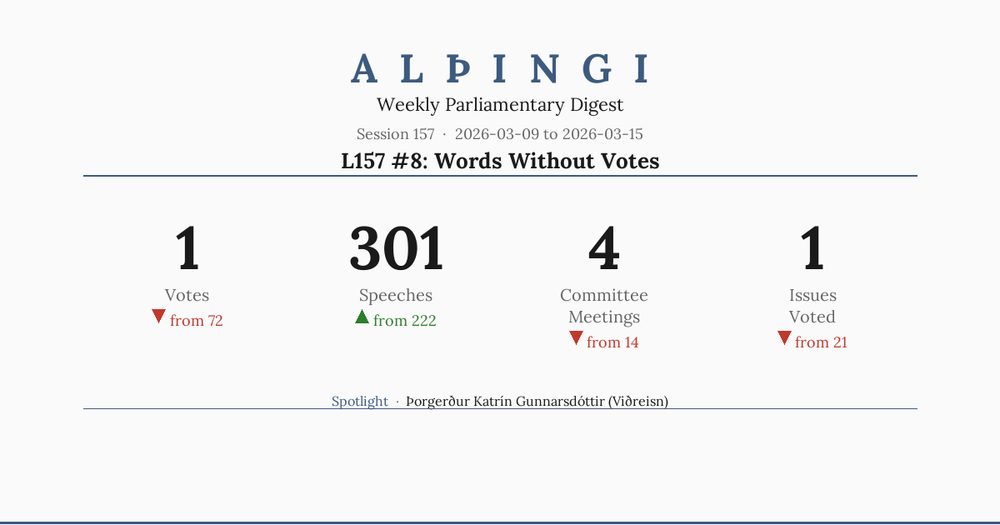
243 speeches in a single Monday. One vote all week — a procedural motion to extend the session so the speeches could continue. No new bills introduced. Committee meetings down from 14 to four. Welcome to the week Alþingi stopped legislating and started performing.
The government's proposal for a referendum on EU accession talks — scheduled for 29 August, asking simply whether to resume negotiations suspended in 2013 — arrived on Monday 9 March with the force of a depth charge dropped into still water. By the end of the day, the chamber had delivered 243 speeches on the topic. By Monday, the week's total had reached 301. The opposition, led by Sjálfstæðisflokkur (the Independence Party) and Miðflokkurinn (the Centre Party), had deployed everything available to slow proceedings: procedural challenges, cascading andsvar rounds, pointed demands that Foreign Minister Þorgerður Katrín Gunnarsdóttir appear before the utanríkismálanefnd (Foreign Affairs Committee) before the debate was allowed to continue. The coalition held the line. The session was extended by 31 votes to 18.
The procedural objections were not merely tactical, even if tactics were clearly in play. Diljá Mist Einarsdóttir of Sjálfstæðisflokkur raised a genuine legal point: the government had not conducted the mandatory consultation required under parliamentary rules before presenting the resolution. Bryndís Haraldsdóttir — notably not from the opposition but a coalition critic on process — added that the samráðsgátt (public consultation portal) had been bypassed entirely, with details of the referendum reportedly appearing in EU media before Iceland's own parliament had been properly briefed. These were real procedural failures, and the government's supporters were unpersuasive in explaining them away.
But procedural failure and political strategy make comfortable bedfellows. The sustained effort to slow the debate had the logic not of law-enforcement but of attrition. Guðlaugur Þór Þórðarson of Sjálfstæðisflokkur returned 16 times to ask what EU membership would actually entail — hvað felst í því, what does this involve — a question designed to exhaust the government's answers rather than receive them. Jón Pétur Zimsen, also of Sjálfstæðisflokkur, spent 15 interventions restating the legal fiction of permanent EU exemptions. Sigmundur Davíð Gunnlaugsson of Miðflokkurinn relitigated, across 19 speeches, the Foreign Minister's recent trips to Brussels. The goal was not persuasion but fatigue.
The coalition's position had its own vulnerabilities. Halla Hrund Logadóttir of Framsóknarflokkur (the Progressive Party), a coalition partner, made the most substantive demand from any direction: the government needed to set out its own reasoning, not just put the question to the people. What specifically had changed since 2009? What were the negotiating objectives? The referendum's framing — do you want to find out more? — was politically elegant but analytically thin. Þorgerður Katrín's opening speech was eloquent on the changed geopolitical environment, invoking Canadian Prime Minister Mark Carney's recent comments on medium-sized states needing to band together in a world of great-power competition. Whether that argument is sufficient to carry a referendum remains an open question.
Framsóknarflokkur's coalition loyalty had its own internal tensions. Jóhann Friðrik Friðriksson pressed the Prime Minister on whether full sovereignty over natural resources could genuinely be guaranteed in any accession agreement — a question the party has used to maintain internal coherence for decades. The coalition's committee chair, Pawel Bartoszek, promised the utanríkismálanefnd would treat the case with full parliamentary care, without being quite able to promise that everyone would be satisfied.
The week's single vote tells the deeper story. A parliament that generated 70,323 words of debate and recorded exactly one division has revealed the limits of its own procedure. The Alþingi's rules allow the opposition to generate this kind of friction; the government's decision to introduce the resolution without adequate preparation invited it. Both are simultaneously true.
The irony is that this was, constitutionally speaking, a democratic achievement. A small country debated the biggest foreign policy question it has faced in decades, openly, in parliament, over two days of sustained argument. The 243 speeches were evidence that Icelanders take sovereignty seriously. They were also evidence that parliamentary time is a finite resource that can be consumed by the argument before it reaches the decision — which may, of course, have been rather the point.
Week at a Glance
|
1
▼ from 72
Votes |
301
▲ from 222
Speeches |
4
▼ from 14
Committee Meetings |
1
▼ from 21
Issues Voted |
Party Voting Patterns
Absence Rate
Most Words Spoken
Parliamentary Awards
Session 157 • Recognising the quirks and patterns of Althingi
Mic Drop of the Week
The single best speech of the week — as judged by our parliamentary critic.
The most effective opposition move of the week did not involve procedural motions, statutory citations, or the 16-question framework being applied across the chamber by her Sjálfstæðisflokkur colleague. It involved two quotations and a silence.
Guðrún Hafsteinsdóttir rose on Monday afternoon to address the Prime Minister rather than the Foreign Minister — a deliberate choice. She quoted Kristrún Frostadóttir's August 2024 interview, in which Kristrún had said this was not the right moment for EU accession talks, that the process demanded an enormous mandate, broad social consensus, support from business and the trade union movement, not just one or two political parties — and that she would never, aldrei, go back on her word. Then she quoted the New Year's address: "Leyfum engum að kljúfa okkur. Höfnum svartagallsrausi um að íslenska leiðin sé ekki lengur fær" — let no one divide us, reject the notion that the Icelandic way is no longer viable.
Then she asked: what has actually changed, other than the Prime Minister's record of failure on the economy?
"Hvað hefur raunverulega breyst síðan hún sagði sjálf að þetta væri ekki rétti tíminn?" — What has actually changed since she herself said this was not the right time?
No rebuttal was possible that did not also indict the Prime Minister's previous statements. The speech was 246 words. It required no data beyond what Kristrún had said herself. It is the oldest opposition technique — turning a minister's own record into their prosecution — executed with the precision that makes it devastating rather than merely pointed.
“Hvað hefur raunverulega breyst síðan hún sagði sjálf að þetta væri ekki rétti tíminn og hvað hefur breyst um að þetta ferli krefðist mikillar samstöðu þjóðarinnar og sterks umboðs, frá því að hún hvatti þjóðina um áramótin til að hafna þeirri hugsun að íslenska leiðin dygði ekki?”
What has actually changed since she herself said this was not the right time, and what has changed about this process requiring broad national consensus and a strong mandate, since she urged the nation at New Year's to reject the notion that the Icelandic way was no longer viable?
Guðrún Hafsteinsdóttir (Sj) — 246 words on þjóðaratkvæðagreiðsla um framhald viðræðna um aðild Íslands að Evrópusambandinu (2026-03-09).
Turned the PM into her own most effective opposition witness — no rebuttal needed when the contradictions speak for themselves.
Sharpest Question
The most incisive question or challenge posed in debate this week.
The government spent the week arguing the merits of resuming EU accession talks. Sigríður Á. Andersen of Miðflokkurinn spent the week asking why the government was afraid of scrutiny.
Her sharpest intervention came late on Monday, when she turned a coalition MP's question back on itself: "Hvað hræðist hv. þingmaður? Hræðist þingmaðurinn að koma hér aftur saman, að þingið fái að tjá sig degi fyrir þessa þjóðaratkvæðagreiðslu?" — what is the honourable member afraid of? Is the member afraid of parliament reconvening the day before the referendum?
The question reframed the entire process objection. The government was seeking a democratic mandate via referendum; why, then, schedule it during a parliamentary recess? Why announce it to European media before briefing MPs? Why bypass the samráðsgátt? Her cascading af hverju? — why? — questions did not attack the EU position itself but the government's apparent wariness of democratic scrutiny at every step before the vote.
The verdict lands not on where Iceland should stand on Europe but on how a government that claims democratic legitimacy should behave when requesting it: transparently, and not in the foreign press before the domestic parliament.
“Hvað hræðist hv. þingmaður? Hræðist þingmaðurinn að koma hér aftur saman, að þingið fái að tjá sig degi fyrir þessa þjóðaratkvæðagreiðslu?”
What is the honourable member afraid of? Is the member afraid of reconvening here, of parliament having its say the day before this referendum?
Sigríður Á. Andersen (M) — on þjóðaratkvæðagreiðsla um framhald viðræðna um aðild Íslands að Evrópusambandinu (2026-03-09).
Flipped the frame from policy debate to democratic accountability — the government could answer every question about the EU except why they were afraid of parliament asking them.
Strongest Case
The most persuasive argument or policy case made in debate this week.
“Ég vil vita meira um þetta í þágu íslenskra fjölskyldna, íslenskra heimila og íslensks atvinnulífs.”
I want to know more about this for the benefit of Icelandic families, Icelandic homes, and Icelandic industry.
Þorgerður Katrín Gunnarsdóttir (V), Foreign Affairs Minister — on þjóðaratkvæðagreiðsla um framhald viðræðna um aðild Íslands að Evrópusambandinu (2026-03-09).
Þorgerður Katrín built her EU referendum case across four dimensions: historical precedent (NATO, EFTA, EEA — each controversial at the time, each vindicated), geopolitical reality (Carney's argument about medium states needing alliances), a concrete economic example (Croatian mortgage rates falling post-euro adoption), and an emotional reframing of the entire question as curiosity rather than commitment. The speech anticipated the sovereignty objection and turned it — 'Mér finnst lítið fullveldi fólgið í þeirri afstöðu' — before closing with the deceptively simple 'Vil ég vita meira?' A well-constructed case that the opposition struggled to dismantle on its own terms, choosing instead to attack the process rather than the argument.
Broken Record Award
MPs who repeat themselves most — same catchphrases, recycled arguments, and recurring anecdotes across different speeches.
Guðlaugur Þór Þórðarson (Sjálfstæðisflokkur, 16 speeches) — deployed hvað felst í því, what does this entail, like a parliamentary stress test across 16 interventions, daring coalition MPs to explain what EU membership actually requires, knowing that an honest answer was more useful to him than any rebuttal.
Jón Pétur Zimsen (Sjálfstæðisflokkur, 15 speeches) — built his filibuster contribution around a single thesis: that permanent EU exemptions are a legal fiction. He restated it with the mechanical persistence of someone who knows the other side has no clean answer, because the answer is complicated and complications are his preferred terrain.
Þorgerður Katrín Gunnarsdóttir (Viðreisn, 22 speeches) — anchored 22 speeches in a rotating defence of three talking points: guard sovereignty, continue talks, never sign a bad deal. The disciplined consistency of a minister holding a coalition position under sustained fire; it reads as repetition on paper and as line-holding in practice.
Sigmundur Davíð Gunnlaugsson (Miðflokkurinn, 19 speeches) — treated every exchange as an opportunity to relitigate the Foreign Minister's Brussels trips, 19 times across two days. Less a rhetorical strategy than a grievance that refuses to stay resolved, which may be the same thing from a different angle.
Stefán Vagn Stefánsson (Framsóknarflokkur, 13 speeches) — found a comfort phrase and leaned into it: Iceland's interests are better served outside the EU, stated three times in as many different registers. A verbal anchor in waters his coalition position makes genuinely uncertain.
| Name | Speeches | Top Catchphrase | Uses |
|---|---|---|---|
| Guðlaugur Þór Þórðarson (Sj) | 16 | “hvað felst í því að” | 7× |
| Jón Pétur Zimsen (Sj) | 15 | “það eru engar varanlegar” | 5× |
| Þorgerður Katrín Gunnarsdóttir (V) | 22 | “skrifa undir samning sem” | 5× |
| Sigmundur Davíð Gunnlaugsson (M) | 19 | “umsókn um aðild að” | 4× |
| Stefán Vagn Stefánsson (Fr) | 13 | “hagsmunum íslands sé betur borgið” | 3× |
1. Guðlaugur Þór Þórðarson (Sjálfstæðisflokkur)
Deployed "hvað felst í því" like a parliamentary stress test — each repetition daring coalition MPs to explain what EU membership actually requires, knowing the answer stays the same.
- “hvað felst í því að” (7×) —
- “í því að vera í” (6×) —
2. Jón Pétur Zimsen (Sjálfstæðisflokkur)
Built his entire filibuster around a single thesis — that permanent EU exemptions are a legal fiction — and restated it with the mechanical persistence of someone who knows the other side has no answer.
- “það eru engar varanlegar” (5×) —
- “snýst að miklu leyti um” (4×) —
3. Þorgerður Katrín Gunnarsdóttir, Foreign Affairs Minister (Viðreisn)
Anchored 22 speeches in a rotating defence of three talking points — guard sovereignty, finish negotiations, never sign a bad deal — the disciplined consistency of a minister holding the line under sustained fire.
- “skrifa undir samning sem” (5×) —
- “standa vörð um” (5×) —
- “halda áfram viðræðum um” (4×) —
Data sourced from Althingi Open Data (althingi.is). Generated 2026-03-15.
MP Spotlight
A deep dive into one parliamentarian each week
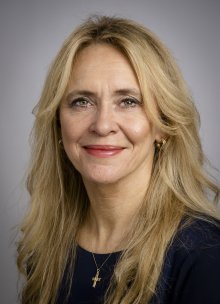
Þorgerður Katrín Gunnarsdóttir
Foreign Affairs Minister, Viðreisn
Born 1965-10-04
Stúdentspróf MS 1985. Lögfræðipróf HÍ 1993.
|
117 speeches this session |
45,408 words total |
388 words avg per speech |
She has held almost every major political identity available to an Icelander of her generation. She entered parliament in 1999 as a member of Sjálfstæðisflokkur (the Independence Party) — the natural home for a lawyer's daughter from Reykjavík who had chaired the law students' union and served on the Hafnarfjörður local party board. She served as Education Minister for more than five years, one of the longest tenures in that role in modern Icelandic history. Then she did something unusual: she left her party, helped found a new one, and rebuilt herself from scratch. Þorgerður Katrín Gunnarsdóttir is now Foreign Minister, and this week she presented the resolution that could define Iceland's relationship with Europe for a generation.
Born in Reykjavík on 4 October 1965 to an actor father and a civil servant mother, Þorgerður Katrín took her matriculation in 1985 and her law degree from the University of Iceland in 1993. Her early career moved between legal practice, public broadcasting — she headed the society and current affairs division at the national broadcaster RÚV between 1997 and 1999 — and party structures. She became an MP for Reykjanes in 1999, moved to the South-West constituency in 2003, and has sat there ever since, first under the Sjálfstæðisflokkur banner and, since 2016, under Viðreisn (Reform Party).
The years 2003 to 2009 were her first cabinet stretch. As Education Minister she oversaw a period of significant expansion in Icelandic higher education and navigated the early years of what would become a generational debate about university funding. Her departure from government coincided with the financial crash of 2008, and her departure from Sjálfstæðisflokkur came later — a slower, more deliberate break.
The founding of Viðreisn is the most telling chapter in her political biography, and it cannot be understood without the specific wound that caused it. When the accession talks with the EU were suspended in 2013 — without a referendum, without asking the public — Þorgerður Katrín saw it as a betrayal of what she believed her party had implicitly promised. In an interview from that period she put it with characteristic directness: the hardliners inside Sjálfstæðisflokkur had been allowed to own the party in a way that she could no longer accept. She spent the following two years working through that conclusion, and by 2016 she had gone — moving to Viðreisn along with Þorsteinn Pálsson and other liberals who drew the same line at the same point. The party she helped build was founded, in part, to reopen the question that had been closed without her consent.
That takes some accounting. She paid a real political price: leaving the biggest party in the country, restarting in a small new formation, spending years as a minor-party MP when she had once been deputy leader of the dominant force in Icelandic politics. The gamble she made in 2016 was that the question would eventually return and that she would be there to ask it. She was right. On Monday 9 March 2026 — almost exactly ten years after she crossed the floor — Þorgerður Katrín rose in Alþingi to present the resolution for a referendum on resuming EU accession talks, set for 29 August 2026. The circle closed.
The speech ran to 2,093 words — the longest of an extraordinary week — and it was notable both for what it said and what it did not. She did not promise EU membership. She promised the nation a question: do you want to resume talks? The binary simplicity was deliberate. The referendum, she argued, was not about the merits of membership but about whether Iceland should acquire the information to make that judgment. A yes vote would restart negotiations; a further referendum would follow any completed accession deal. Her closing pitch was almost homely in its reduction of a geopolitical decision to individual conscience: "You don't need to become an EU expert by 29 August — just look into your heart and ask: do I want to know more?"
The geopolitical framing was the speech's most substantive contribution. She cited Canadian Prime Minister Mark Carney's analysis of medium-sized states needing to consolidate their positions in a world of great-power competition. She noted that tariffs were being imposed without warning even by allies, that trade was being weaponised, that border integrity was being ignored. Iceland, she argued, had responded well to previous moments of strategic choice — NATO membership, EFTA accession, the EEA agreement — and had been better for each decision. The question was whether this generation had the courage to face a comparable moment.
The public was divided almost exactly in half. A Gallup poll published on the day the debate opened showed 52% in favour of resuming talks and 48% opposed — a margin so thin that it invites comparison with other moments when democracies have been asked to vote on European integration with roughly this kind of split, and have found that the aftermath is more complicated than the vote. Þorgerður Katrín, when asked about the margin, said she would accept a result of 51%. Her coalition partner, Prime Minister Kristrún Frostadóttir, has spoken of needing a broad majority. That is a visible fault line in the coalition, not a minor semantic disagreement. The question of what counts as a sufficient mandate for resuming talks — and whether a win of one or two percentage points would actually unlock negotiations in a politically durable way — is one the government has not answered.
Her opponents questioned the timing, the process, and the premise. The procedural objections were acute: the government had bypassed the mandatory consultation process, failed to brief the utanríkismálanefnd (Foreign Affairs Committee) before announcing the resolution, and allowed details of the referendum date to appear in EU media before Alþingi had been formally informed. Diljá Mist Einarsdóttir read the relevant statutory provision from the floor — consultation is mandatory for major foreign affairs matters — and asked how this could be called anything other than a breach. Þorgerður Katrín's defence was that the committee had received written notification and that the process remained ongoing. Her critics found this unconvincing.
The deeper challenge came from an unexpected quarter. Guðrún Hafsteinsdóttir of Sjálfstæðisflokkur produced the Foreign Minister's own coalition partner — Prime Minister Kristrún — as her most effective opposition witness, quoting Kristrún's August 2024 interview in which she had said the time was not right for this process, that it required enormous national consensus and broad public support before beginning. She then quoted the Prime Minister's New Year address urging Icelanders to reject the notion that the Icelandic way was no longer viable. Her question — "what has actually changed?" — was the sharpest of the week, and it landed on the Foreign Minister as much as on the Prime Minister.
The timing question had a geographical dimension too. On 10 March — the day the parliamentary debate was reaching its most intense pitch, with more than 240 speeches delivered in something close to a parliamentary filibuster — Þorgerður Katrín flew to Washington. She met Christopher Landau, the Deputy Secretary of State, alongside officials handling defence and trade portfolios. The subjects were serious: NATO spending commitments, Ukraine's potential accession, Greenland. She reported back that Iceland would likely not escape higher NATO burden-sharing expectations. The trip was necessary foreign policy work. It was also, as her critics in the chamber were quick to note, an absence on the day the parliament was most exercised about her resolution. A minister who presents a referendum motion and then leaves the country while colleagues debate it for sixteen consecutive hours will find that the optics follow her across the Atlantic.
Þorgerður Katrín's responses across 22 speeches and multiple andsvar rounds — the parliamentary back-and-forth — were consistent to the point of becoming their own rhetorical pattern. Three phrases recurred: standa vörð um (protect and stand guard over), skrifa undir samning (sign a deal), halda áfram viðræðum um (continue talks on). The discipline was real — she was holding a coalition position under sustained fire, with Framsóknarflokkur partners pressing her on resource sovereignty, Miðflokkurinn questioning her travel schedule, and Sjálfstæðisflokkur treating every response as an opportunity for another procedural intervention. That she maintained coherent messaging through 22 interventions over two days is, in its own way, a ministerial achievement. Whether consistency under pressure is the same thing as persuasion is a different question, and one the next five months will test.
Her voting record in session 157 reflects the same discipline: 100% loyalty across 260 recorded votes, with 278 absences consistent with a minister frequently engaged outside the chamber. She has spoken across 33 distinct issues, with 117 speeches totalling 45,408 words — the most voluminous output of any minister this session. The career spans 30 parliamentary sessions.
There is a version of Þorgerður Katrín's story that reads as remarkable coherence: the same European conviction, held through a change of party and a decade in opposition, now finally in a position to act on it. The politician who was told in 2013 that the question was closed is the minister who has reopened it. There is another version that reads differently — a politician who has staked her most senior cabinet role on a referendum she needs to win, presented in a week when her own procedural management gave the opposition legitimate grievances to run alongside their political objections, with a coalition that cannot agree on what winning even means.
Both versions are probably right. And the 52–48 poll does not resolve the tension between them.
What is not in doubt is the scale of what she has set in motion. The 29 August referendum will be the first direct democratic test of Icelandic EU opinion in the modern era. The question — resume talks or do not — is narrower than the membership question, but the politics will not be narrow. The arguments deployed in parliament this week, on all sides, are the arguments that will be deployed in every community in Iceland for the next five months. Þorgerður Katrín has spent a decade building toward this moment. She now has to make a case that is more than geopolitical theory and procedural defence — to give voters a reason to say yes that goes beyond being told they deserve the chance to find out more.
She left Sjálfstæðisflokkur because she believed a party had denied the public a vote it was owed. If 29 August produces a margin of one or two points, the argument about what the public has actually decided will begin immediately. Having spent ten years insisting that the people must be trusted to answer the question, she will need to be the first to accept whichever answer they give.
Key Legislation & Votes
Stage key: 1st reading • In committee • 2nd reading • 3rd reading • Enacted
Get Þingfréttir by email
Weekly parliamentary digest — straight to your inbox every Sunday.
Subscribe