L157 #6: Five Laws and One Fish
Editorial: The Week in Parliament
Fifty-eight votes in a single week — up from just one the week before — and the Althingi delivered a legislative sprint that masks a deeper dysfunction. Seven bills cleared final readings on Wednesday alone, most with near-unanimous margins. But the real story of Session 157's sixth week was not what passed. It was the fight over what parliament was allowed to examine before it voted.
The grásleppumál (lumpfish management bill) consumed 23 speeches across three days, yet produced barely any substantive policy debate. Instead, the opposition accused the atvinnuveganefnd (Business Affairs Committee) majority of reneging on a unanimously agreed request for a legal opinion from Lagastofnun (the Legal Institute). The committee chair, Lilja Rafney Magnusdottir of Flokkur folksins (People's Party), countered that the bill had been in play since last spring and that the minority was engaged in indefinite delay. When Jens Gardar Helgason of Sjalfstaedisflokkurinn (Independence Party) demanded the Speaker halt proceedings, the parliamentary machinery creaked to a stop: a formal meeting with party leaders was called, and the Speaker eventually issued a ruling on Article 62 of committee rules. Bergthor Olason of Midflokkurinn (Centre Party) called the ruling an effective "Article 71 for committee work" — a nullification of the minority's right to appeal committee decisions to the Speaker. Whatever one thinks of the lumpfish bill itself, the procedural precedent landed like a depth charge.
Amid the procedural theatre, substantive legislation slipped through with remarkably little friction. Bill 229 on verndar- og orkunytingaraaetlun (nature conservation and energy utilisation planning) passed 48-0, rewriting how Iceland balances hydropower development against environmental protection. Bill 400 on electoral law and domicile rules sailed through unanimously, as did Bill 238 abolishing the Heyrnar- og talmeinastod (Hearing and Speech Institute) — a quiet institutional death with zero opposition votes. The fisheries bill (153 — veidar i fiskveidlandhelgi Islands), by contrast, split the chamber 27-19, the week's tightest margin.
The education debate deserves attention precisely because it broke the procedural pattern. Jon Petur Zimsen of the Independence Party used PISA data like a scalpel: Iceland has collapsed from 10% of students at top proficiency levels to just 2-3%, meaning roughly 300 children per year are, as he put it, "robbed of exceptional capability." Education Minister Inga Saelaend of Flokkur folksins did something rare for a cabinet member — she stayed in the chamber and conceded the point. The inclusion model (skoli an adgreiningar) is "a child of its time," she admitted, and the curriculum is being rebuilt. It was the week's most consequential exchange, tucked between procedural eruptions nobody outside the chamber will remember.
Organised crime also found its way onto the agenda. A special debate on the greiningardeild rikislogreglustjora (National Police Commissioner's intelligence unit) report drew 13 speeches and an unusual admission: the report's author, now MP Stefan Vagn Stefansson of Framsoknarflokkurinn (Progressive Party), noted that the warning he helped write in 2008 — that organised crime groups would grow from five to many more — had been proved right. The groups have roughly tripled in 18 years. Parliament discussed. Parliament did not act.
A parliament that passes seven bills in a day while fighting for three days over whether it may consult a lawyer is not paralysed. It is efficient about the things nobody opposes and theatrically engaged on the things that matter. The irony is that the week's most consequential admission — a minister conceding her education model has failed a generation — happened in the quietest debate, while the loudest fight was about the right to ask a question that might already have been answered.
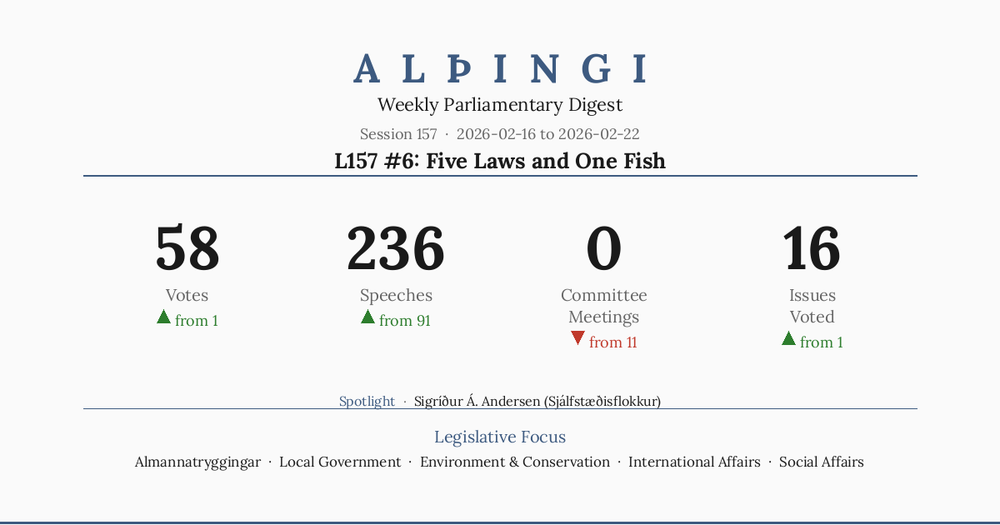
Week at a Glance
|
58
▲ from 1
Votes |
239
▲ from 88
Speeches |
0
▼ from 11
Committee Meetings |
16
▲ from 1
Issues Voted |
Legislative focus: Almannatryggingar (3), Local Government (3), Environment & Conservation (3), International Affairs (2), Social Affairs (2)
Party Voting Patterns
Absence Rate
votes with tallies
Individual Votes
Most Words Spoken
Parliamentary Awards
Session 157 • Recognising the quirks and patterns of Althingi
The Awards Column
The opposition dominated the microphone this week so completely that the governing majority's most distinctive parliamentary activity was silence. Five coalition backbenchers cast every available vote while delivering zero speeches — a feat of disciplined presence that raises a question no whip will answer: were they instructed not to speak, or did they simply have nothing to add while the opposition tore itself hoarse over committee procedure? Meanwhile, the education debate that arguably mattered most attracted fewer participants than a routine fisheries vote, and the minister who conceded her own policy's failure got less attention than the MPs who spent three days arguing about the right to ask a question.
Mic Drop of the Week
The single best speech of the week — as judged by our parliamentary critic.
Jon Gunnarsson of Sjalfstaedisflokkurinn (Independence Party) aimed a 182-word broadside at Social and Housing Affairs Minister Ragnar Thor Ingolfsson, calling his combative rhetoric that of an "otindur gotustrákur" (uncouth street kid) rather than a government minister. The insult landed precisely because Jon backed it with an inconvenient coalition of agreement: former trade union colleagues of the minister, the Confederation of Icelandic Employers, and the Central Bank governor had all, that same morning, sided with the opposition's position on the social insurance bill. When everyone from the labour movement to the central bank agrees with your critics, dismissing them as shills for the wealthy is not just wrong — it is strategically reckless. The Speaker intervened to remind MPs to mind their language, but the damage was already in the parliamentary record.
“Þetta er eins og ótíndur götustrákur sé hér á ferð en ekki ráðherra í ríkisstjórn Íslands”
It's as if an uncouth street kid were at work here, not a minister in the government of Iceland
Jón Gunnarsson (Sj).
Jón Gunnarsson delivered a scathing 182-word rebuke of the housing minister's conduct, calling his rhetoric that of an 'ótíndur götustrákur' (uncouth street kid) rather than a government minister. The speech crystallized opposition fury at what they saw as the minister dismissing critics as shills for the rich — while labour unions, employers' associations, and the central bank governor all shared the opposition's concerns.
Sharpest Question
The most incisive question or challenge posed in debate this week.
Jon Petur Zimsen of the Independence Party confronted Education Minister Inga Saelaend with Iceland's collapse in top-tier PISA performance: from roughly 10% of students at the highest proficiency levels to just 2-3%, a gap he calculated as 300 children per year denied a foundation for excellence. "Hver ber abyrgd a thvi ad 300 nemendur seu i raun raendir thessari afburdahaefni?" (Who bears responsibility for 300 students essentially being robbed of this exceptional capability?) The question forced the minister into the week's most consequential admission: the inclusion model — skoli an adgreiningar — is, she conceded, "barn sins tima" (a child of its time), outdated and in need of fundamental reform. A question that produces a policy concession rather than a deflection is the rarest commodity in parliamentary debate.
“Hver ber ábyrgð á því að 300 nemendur séu í raun rændir þessari afburðahæfni?”
Who bears responsibility for 300 students essentially being robbed of this exceptional capability?
Jón Pétur Zimsen (Sj).
Jón Pétur Zimsen confronted the education minister with devastating PISA data: Iceland has only 2% of students at the highest proficiency levels in science (vs 8-9% in Nordic peers) and 3% in reading. He calculated that roughly 300 children per year are being denied the foundation for excellence, asking 'Hvar er metnaðurinn?' — forcing the minister into a remarkably candid admission that the inclusion model is 'barn síns tíma' (a relic of its time).
Broken Record Award
MPs who repeat themselves most — same catchphrases, recycled arguments, and recurring anecdotes across different speeches.
Sigridur A. Andersen (Midflokkurinn) — 16 speeches, score 8. The lawyer in her refused to stop until the procedural record was complete, cycling between the Landspitali crisis and the fishing committee breach as twin exhibits in a single prosecution of government negligence.
Bergthor Olason (Midflokkurinn) — 15 speeches, score 7. His Article 62 invocations gave the procedural fight constitutional gravity, framing a committee dispute as a precedent that would haunt future minorities of every political stripe.
Jon Gunnarsson (Sjalfstaedisflokkurinn) — 14 speeches, score 7. The opposition's procedural attack dog turned a fisheries technicality into a constitutional employment-rights case, arguing lumpfish catchers' livelihoods were being legislated away without adequate legal scrutiny.
Jon Petur Zimsen (Sjalfstaedisflokkurinn) — 9 speeches, score 6. Fewer interventions but sharper ammunition: the same PISA collapse data redeployed across five speeches until the minister conceded the system needs rebuilding.
Inga Saelaend (Flokkur folksins) — 4 speeches, score 5. The education minister's broken record was an unusually candid one: the inclusion model has expired, the curriculum is being rewritten, and she will personally fight for better outcomes. Repetition in the service of a concession is still repetition, but it is the kind parliament should hear more often.
| Name | Speeches | Top Catchphrase | Uses |
|---|---|---|---|
| Sigríður Á. Andersen (M) | 16 | “Landspítalinn og einkaaðilar” | 3× |
| Bergþór Ólason (M) | 15 | “62. grein starfsreglna og vísun til forseta” | 7× |
| Jón Gunnarsson (Sj) | 14 | “Réttindi minni hlutans í atvinnuveganefnd” | 9× |
| Jón Pétur Zimsen (Sj) | 9 | “Hrun í PISA-árangri” | 5× |
| Inga Sæland (Ff) | 4 | “Skóli án aðgreiningar er úreltur” | 3× |
1. Sigríður Á. Andersen (Miðflokkurinn)
The week's busiest MP hammered two drums relentlessly: the Landspítali hospital crisis (demanding to know why the minister waited until emergency conditions to accept private-sector help) and procedural violations in the fishing committee (repeatedly invoking Article 62 of committee rules). 16 speeches, one unmistakable message: this government is reactive and tramples parliamentary norms.
- “Landspítalinn og einkaaðilar” (3×) — Challenged the health minister on why Landspítali only accepted help from Klíníkin when already in crisis mode.
- “Málsmeðferðarbrot í atvinnuveganefnd” (8×) — Relentlessly pursued the majority's reversal of a unanimously agreed legal review, invoking committee rules and parliamentary procedure.
- “Varúð við skipulagða glæpastarfsemi” (2×) — Warned that prosecutorial powers need careful oversight given recent controversies.
2. Bergþór Ólason (Miðflokkurinn)
Bergþór Ólason joined the procedural chorus in the fishing committee fight with 15 speeches, but added a distinctive constitutional tenor. His invocations of Article 62 of committee rules and comparisons to the parliamentary crisis of July 2025 gave the procedural fight a gravity that elevated it beyond routine obstruction.
- “62. grein starfsreglna og vísun til forseta” (7×) — Formally invoked the minority's right to appeal to the Speaker when expert review requests are wrongfully denied.
- “Samanburður við júlíkreppuna 2025” (3×) — Warned that the majority's behaviour mirrors the parliamentary breakdown of last summer.
3. Jón Gunnarsson (Sjálfstæðisflokkur)
Jón Gunnarsson was the opposition's procedural attack dog this week, delivering 14 speeches almost entirely focused on the fishing committee drama. His refrain: the majority illegally blocked an expert review that had been unanimously approved, violating constitutional employment rights of lumpfish fishers. The housing minister confrontation was a sharp detour but the committee fight was his broken record.
- “Réttindi minni hlutans í atvinnuveganefnd” (9×) — Argued the majority violated parliamentary rules by reversing an agreed Lagastofnun legal review on the lumpfish bill.
- “Stjórnarskrárvarin atvinnuréttindi” (3×) — Framed the lumpfish bill as a constitutional issue, not a minor fisheries technicality.
Data sourced from Althingi Open Data (althingi.is). Generated 2026-02-22.
MP Spotlight
A deep dive into one parliamentarian each week

Sigríður Á. Andersen
Miðflokkurinn
Born 1971-11-21
Stúdentspróf MR 1991. Lögfræðipróf HÍ 1999. Hdl. 2001.
|
192 speeches this session |
76,647 words total |
399 words avg per speech |
Sigríður Á. Andersen: The Lawyer Who Never Rests Her Case
The most prolific voice in Iceland's parliament this session belongs to a former Justice Minister who crossed party lines, inherited leadership of the opposition's most combative faction, and now speaks more than anyone else in the chamber — by a wide margin. Sigríður Á. Andersen of Miðflokkurinn (the Centre Party) delivered 16 speeches in a single week, topping the speaker charts with 3,603 words. That output is not an anomaly. Across the full 157th session, she has logged 192 speeches and 76,647 words, earning the title ræðudrottning — "queen of speeches" — from Morgunblaðið after the autumn session, where she spent nearly 13 hours at the podium. Her career total stands at 1,013 speeches and 398,168 words across 14 parliamentary terms. Born in Reykjavik in 1971, trained as a lawyer at the University of Iceland, she practised at LEX as a district court attorney before entering parliament for Sjálfstæðisflokkurinn (the Independence Party) in 2015. She served as dómsmálaráðherra (Justice Minister) from 2017 to 2019, resigned in the aftermath of the Landsréttur judicial appointment scandal, then crossed the aisle to Miðflokkurinn in 2024 — bringing her legal expertise and her combative streak to a party that welcomed both. The numbers alone make her impossible to ignore. What makes her consequential is how she uses the floor.
Thematic Profile
Two clusters define Sigríður's parliamentary identity this session: the vigilant constitutionalist and the property-rights conservative.
The constitutionalist surfaces whenever legislation brushes against individual liberties or procedural norms. Her 2,357-word intervention on the UN Convention on the Rights of Persons with Disabilities was not a rejection of disability rights but a surgical dissection of legislative ambiguity. She argued that parliament was effectively outsourcing the interpretation of rights to courts by passing a broadly worded convention into law without specifying its domestic legal effects — a concern she framed as institutional, not ideological. The same instinct drove her landmark speech on sóttvarnalög (epidemic control legislation), where she picked apart the legal basis for pandemic-era restrictions. And it animates her persistent campaign against Bókun 35 (Protocol 35) of the EES (EEA) agreement, which she frames as Brussels exerting political pressure on Icelandic sovereignty — despite having personally served on the working group that drafted the implementing legislation.
The property-rights conservative emerged most clearly in the fjöleignarhús (condominium law) debates, where Sigríður produced a minority committee report, proposed amendments to protect individual owners' ability to restrict pet ownership in shared buildings, and — when her amendments were voted down — declined to support the final bill. Her argument was characteristically precise: the bill undermined the established hierarchy of decision-making thresholds in condominium law (unanimous consent, two-thirds majority, simple majority) that had served Iceland well for decades. She was willing to support the bill's goals. She refused to accept sloppy execution.
Her voting record adds a useful footnote. With a 98.6% party loyalty rate across 646 votes this session, Sigríður is no rebel — but her nine dissenting votes cluster around tax policy and social insurance, the two areas where her libertarian instincts occasionally outrun the Centre Party whip. She follows the group gladly on most matters but reserves the right to abstain where her convictions run deepest.
This week, those two streams converged. She hammered the government on the Landspítali hospital crisis, demanding to know why the health minister waited until emergency conditions to accept private-sector assistance from Klíníkin. And she launched a sustained procedural assault on the handling of a lumpfish fisheries management bill in the atvinnuveganefnd (Economic Affairs and Trade Committee), invoking Article 62 of committee rules eight times across multiple speeches to argue that the majority had violated a unanimously agreed plan to seek expert review from Lagastofnun (the University of Iceland's Legal Institute).
Rhetorical DNA
Sigríður argues like a district court lawyer who wandered into parliament and refused to adjust her standards of evidence. Her speeches build through accumulation of procedural facts, legal citations, and constitutional references before arriving at a conclusion she treats as self-evident. When she challenged the condominium bill, she did not simply object — she traced the legislative history through two parliamentary sessions, recounted the specific committee meeting where a previously agreed amendment was withdrawn during a summer recess session, and identified the precise moment the consensus collapsed. The effect is prosecutorial: by the time she delivers her verdict, the audience has already been walked through the case file.
Her second characteristic move is the question that answers itself. On the budget, she asked the Finance Minister how a 3.9 billion krona increase in capital contributions could be funded when the previous 3.7 billion temporary allocation was being eliminated — then observed that saying it would be "sorted out" was not an answer parliament should accept. The technique works because she understands the procedural machinery well enough to ask questions her targets cannot easily deflect.
Favourite Catchphrases
| Phrase (Icelandic) | Translation | Usage |
|---|---|---|
| a.m.k. | "at least" / "at minimum" | 73 times (this session) — her rhetorical floor-setter, establishing minimum acceptable standards |
| þegar kemur að | "when it comes to" | 60 times (this session) — pivots from general principles to specific cases |
| vegna þess að | "because of the fact that" | 79 times (this session) — insists on causal reasoning, never leaves assertions unsupported |
| varhugaverð nálgun | "a dangerous/worrying approach" | Recurring (this session) — her preferred verdict on sloppy legislation |
| bandormur ríkisstjórnarinnar | "the government's tapeworm" | On tax legislation (this session) — describing bills that arrive late, poorly prepared, and bloated |
| hræðilegt skrifræðismál | "a terrible bureaucratic affair" | On rental housing legislation (this session) — her shorthand for regulatory overreach |
Emotional Register
The patient pedagogue. In her condominium law speeches, Sigríður methodically explains legal hierarchies — which decisions require unanimous consent, which need two-thirds, which need a simple majority — as though briefing a colleague unfamiliar with the statute. Her tone is collegial, almost tutorial, and she repeatedly emphasises that she supports the bill's aims. The restraint makes her ultimate refusal to vote for it more striking: she has taught the audience exactly why the bill fails on its own terms.
The exasperated proceduralist. This register appeared eight times in a single week during the lumpfish fisheries dispute. Each speech escalated slightly — from questioning whether committee procedures had been followed, to invoking Article 62, to requesting an emergency meeting with the Speaker, to formally reserving her position on the Speaker's ruling. The frustration is real but controlled, and she channels it into increasingly precise procedural claims rather than personal attacks. When she described the majority's reversal of a unanimously agreed expert review as incompatible with þingskapalög (parliamentary procedure law), her voice carried the irritation of a lawyer watching opposing counsel ignore a court order.
The Christmas diplomat. Her jólakveðjur (Christmas greetings) speech — a brief, warm address thanking the Speaker and parliamentary staff — revealed a register entirely absent from her legislative work. She quoted Ecclesiastes, praised her colleagues' tolerance for political rough-and-tumble, and asked the entire chamber to rise in appreciation of the staff. The shift suggests someone who genuinely values the institution she spends most of her time critiquing.
The Verdict
Sigríður Á. Andersen is the opposition's most effective single-issue parliamentarian who happens to care about a dozen issues. Her legal training gives her an unusual advantage: she reads legislation the way it will be read by courts, not the way it was intended by ministers. That makes her genuinely useful in committee, where her amendments — even when rejected — force the majority to confront technical weaknesses they might otherwise paper over.
Her weakness is volume. At 192 speeches this session, she risks the diminishing returns that come with being parliament's most frequent speaker. When every procedural irregularity triggers multiple interventions, the distinction between significant and routine objections blurs. The lumpfish dispute this week was substantively important — the majority did reverse a unanimously agreed committee process — but eight speeches on the same procedural point in a single day tested even sympathetic colleagues' attention spans.
The party switch from Sjálfstæðisflokkurinn (the Independence Party) to Miðflokkurinn freed her from the constraints of a large party and gave her a platform to operate as a legal conscience. As chair of the Centre Party's parliamentary group since October 2025, she now sets the tactical tempo for the opposition's most vocal faction. Whether that amounts to effective opposition or procedural attrition depends on whether she can resist the temptation to litigate everything — and trust that some arguments are strong enough to make once.
Key Legislation & Votes
Legislation Advancing
Legislation Advancing
| Issue | Title | Stage | Vote |
|---|---|---|---|
| #146 | staðfesting ríkisreiknings 2024 | In committee | |
| #400 | kosningalög, sveitarstjórnarlög og lögheimili og aðsetur | Enacted | Bill advances to 3rd reading — samþykkt (48/0) |
| #229 | verndar- og orkunýtingaráætlun og raforkulög | Enacted | Bill advances to 3rd reading — samþykkt (48/0) |
| #232 | grunnskólar | In committee | |
| #479 | áfengislög | ||
| #451 | afnám erfðafjárskatts | Awaiting 2nd reading | Resolution advances |
| #368 | Almannaheillasjóður | Awaiting 2nd reading | Resolution advances |
| #155 | almannatryggingar | Awaiting 3rd reading | Bill advances (after 2nd reading) — samþykkt (32/11) |
Stage key: 1st reading • In committee • 2nd reading • 3rd reading • Enacted
Get Þingfréttir by email
Weekly parliamentary digest — straight to your inbox every Sunday.
Subscribe