L157 #5: One Vote, One Question
Editorial: The Week in Parliament
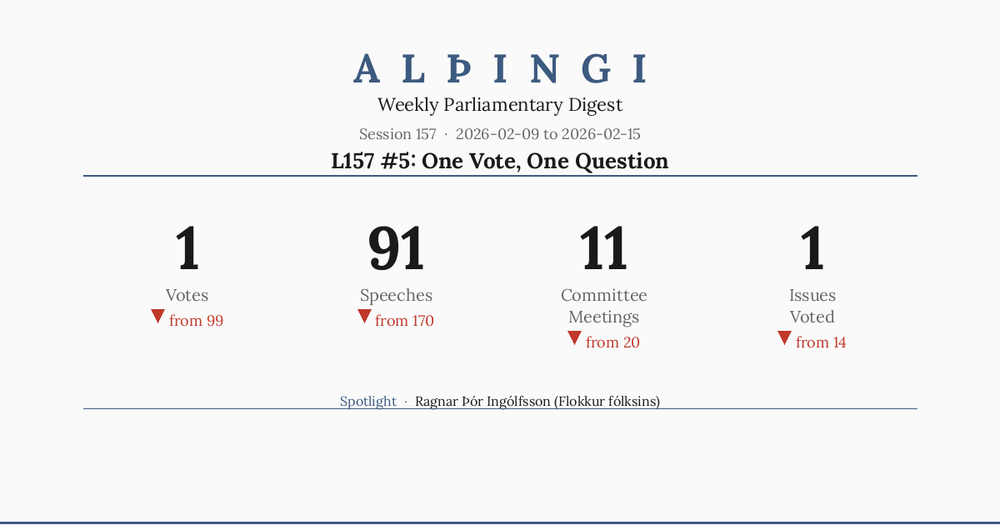
One vote. The Althingi held ninety-nine roll calls the week before; this week it managed one — a dagskrártillaga (agenda motion) on the immigration bill, defeated 29-19 along coalition-opposition lines, surprising nobody and altering nothing. Session 157's fifth week produced the thinnest floor record since October, and the most revealing.
The lone vote masked a government strategy that only becomes visible when you look at where the work actually happened. The umhverfis- og samgöngunefnd (Environment and Transport Committee) absorbed 109 of the week's 179 public submissions, nearly all tied to the energy and resource planning bill (issue 229). When a single committee draws more citizen testimony in five days than parliament held speeches, the country is telling legislators something — and the legislators, to their credit or their frustration, are listening from the committee room rather than the chamber floor. Velferðarnefnd (Welfare Committee) and allsherjar- og menntamálanefnd (General Affairs and Education Committee) split the remainder with 31 submissions each, the first processing an immigration bill now awaiting its third reading, the second handling unemployment insurance concerns that have been accumulating since autumn. Fjárlaganefnd (Budget Committee) held three meetings, the only committee active more than once, quietly advancing a VAT amendment that attracted no headlines and no controversy.
The plenary debate that did occur belonged to two men and a single argument. Ragnar Þór Ingólfsson, Flokkur fólksins (People's Party) — barely a month into his role as félags- og húsnæðismálaráðherra (Social and Housing Affairs Minister) — delivered four speeches totalling 1,394 words, each arriving at the same destination by a slightly different route: housing costs are the defining crisis, shared equity loans are working, and 31 loans went out in the first post-reform allocation against eight before. Facing him, Bergþór Ólason of Miðflokkurinn (Centre Party) filed six interventions across 1,341 words, all orbiting a single procedural grievance: the government pulled the immigration bill from committee on 5 December and has allowed 67 days to pass without scheduling its final reading. Bergþór's complaint has merit. Repeating it five times did not add to that merit.
The week's sharpest moment belonged to neither of them but to Sigurður Ingi Jóhannsson, the former Prime Minister now on the Framsóknarflokkur (Progressive Party) backbench. In 370 words, he methodically dismantled the government's inflation narrative — 5.2% and climbing, unemployment rising, growth stalling — then delivered the week's most quotable line: "Hvað segir Ragnar Þór Ingólfsson í dag? Því að ég man hvað hann sagði 2023." ("What does Ragnar Thor say today? Because I remember what he said in 2023.") It was a parliamentary ambush wearing the mask of a follow-up question. The Progressives fielded only two speakers all week. When one of them is a former prime minister with a good memory, two is enough.
The coalition itself held without strain. Samfylkingin (Social Democrats), Viðreisn (Reform Party), and Flokkur fólksins voted in disciplined unison. Sjálfstæðisflokkurinn (Independence Party) supplied all eleven opposition yes votes, flanked by Miðflokkurinn and a pair of Progressives. The result was never in doubt. The exercise served as a stage for Diljá Mist Einarsdóttir to restock her family-values platform — the family as "hornsteinn samfélagsins" (cornerstone of society), tax deductions for baby supplies, the same catalogue she opened with — and for the coalition to demonstrate it still commands the numbers it needs.
A ninety-nine-vote parliament that drops to one should alarm democratic observers. This one should not. The Althingi did not go quiet because it ran out of arguments. It went quiet because the arguments migrated — to committee rooms processing 179 submissions, to the energy planning bill that will shape Icelandic infrastructure for fifteen years, to the immigration bill waiting in legislative purgatory while both sides pretend urgency and practise patience. The government has discovered that the most effective response to opposition pressure is not to debate it but to let the public submissions process absorb it. Whether that counts as participatory democracy or the most elaborate form of strategic silence in Icelandic legislative history depends, as usual, on which side of the chamber you are sitting.
Week at a Glance
|
1
▼ from 99
Votes |
88
▼ from 165
Speeches |
11
▼ from 20
Committee Meetings |
1
▼ from 14
Issues Voted |
Party Voting Patterns
Absence Rate
Most Words Spoken
Parliamentary Awards
Session 157 • Recognising the quirks and patterns of Althingi
The Awards Column
The same MP won both the week's best speech and the week's highest repetition score. Ragnar Þór Ingólfsson's 708-word address on family welfare was the most consequential thing said in the Althingi between Monday and Friday — real policy, real numbers, a 380-apartment development announced in real time. His other three speeches were the same address wearing different hats. When your strongest performance and your worst habit share a week, what you have is not a contradiction but a diagnosis: a minister who has found the right answer and cannot stop giving it, even when the question has moved on.
The opposition's sharpest blow came from a man who once held the same ministry. Sigurður Ingi Jóhannsson did not need a manifesto. He needed 370 words and a memory. Between them, these two defined the week's real contest: a government building its credibility through housing statistics, and an opposition dismantling it by quoting the government's own promises back at it. The rest of the chamber repeated itself at various frequencies.
Mic Drop of the Week
The single best speech of the week — as judged by our parliamentary critic.
Ragnar Þór Ingólfsson's response to Diljá Mist Einarsdóttir's special debate on family welfare — staða barnafjölskyldna — was the only speech this week that introduced new information into the parliamentary record. A month into his role as félags- og húsnæðismálaráðherra (Social and Housing Affairs Minister), the former VR union chairman answered a hostile debate motion with actual news: extended parental leave for parents of multiples, a shared equity loan scheme delivering 31 approvals in its first post-reform month against eight previously, a 380-apartment development in Hafnarfjörður breaking ground that afternoon, and his first ministerial bill on stofnframlög (capital grants) for non-profit rental housing announced live on the floor. The pivot from defence to policy launch was efficient. The key line — "Þarna getur munað rúmum 100.000 kr. á mánaðarlegum greiðslum" ("That can mean a difference of over 100,000 kr. in monthly payments") — spoke directly to every family in Reykjavik that has done the arithmetic between a market apartment and a non-profit lease. The speech was not elegant. It was something harder to achieve: specific.
“Þarna getur munað rúmum 100.000 kr. á mánaðarlegum greiðslum.”
That can mean a difference of over 100,000 kr. in monthly payments.
Ragnar Þór Ingólfsson (Ff), Social and Housing Affairs Minister — 708 words on Staða barnafjölskyldna (2026-02-10).
The new Social Affairs Minister's debut policy speech converted a hostile opposition-initiated debate into a comprehensive housing and welfare manifesto, pivoting from parental leave reform to shared equity loans to a 380-unit Hafnarfjörður development announced that same afternoon — the rare parliamentary speech that doubles as a press release because the policy receipts are real.
Sharpest Question
The most incisive question or challenge posed in debate this week.
Sigurður Ingi Jóhannsson, the former Prime Minister now on the Framsóknarflokkur (Progressive Party) backbench, delivered a 370-word intervention that functioned less as a question than as a prosecution closing statement. Inflation at 5.2% and rising. Unemployment climbing beyond budget assumptions. Growth decelerating. The government's first-year plan failing on its own metrics. Each data point laid precisely, and the closing line delivered with the timing of someone who has spent years at the dispatch box and knows exactly when to stop talking: "Hvað segir Ragnar Þór Ingólfsson í dag? Því að ég man hvað hann sagði 2023" — "What does Ragnar Thor say today? Because I remember what he said in 2023." The new minister's reply — a pivot to the credit rating upgrade and a recitation of the housing pipeline — confirmed that Sigurður Ingi had located the nerve. When a former prime minister tells a new minister "I remember," the subtext is not reminiscence. It is a standing promise to keep quoting.
“Hvað segir Ragnar Þór Ingólfsson í dag? Því að ég man hvað hann sagði 2023.”
What does Ragnar Þór Ingólfsson say today? Because I remember what he said in 2023.
Sigurður Ingi Jóhannsson (Fr) — on Húsnæðismál og efnahagshorfur (2026-02-09).
The former Prime Minister methodically dismantled the government's inflation narrative — 5.2% and rising, unemployment climbing, growth stalling — then turned the knife by reminding the new minister of his own pre-government rhetoric. The closing line was a parliamentary ambush disguised as a question.
Broken Record Award
MPs who repeat themselves most — same catchphrases, recycled arguments, and recurring anecdotes across different speeches.
Five MPs earned Broken Record citations this week, an unusually high count for a session with only 88 speeches — a testament to how few people were speaking and how often they repeated themselves doing it.
Ragnar Þór Ingólfsson (0.91) deployed "rjúfa kyrrstöðu" (break the stalemate) in four of four speeches, recycled the shared equity loan statistics verbatim, and applied "langstærsta kjaramál samtímans" (the biggest labour issue of our time) identically in separate interventions. The new minister's message discipline has not yet adjusted to a venue where the other side has no obligation to settle.
Þorgerður Katrín Gunnarsdóttir (0.78), the Foreign Affairs Minister, carried exactly three rounds in her rhetorical magazine: the ÍL-fund resolution, the credit rating upgrade from A to A+, and the claim that inflation reflects "one-off effects." Each was discharged in every speech regardless of the question. A minister who has found one favourable number and intends to make it cover every unfavourable one.
Diljá Mist Einarsdóttir (0.72) initiated the family welfare debate and then stocked both her opening and closing speeches from the same display shelf — "hornsteinn samfélagsins" (cornerstone of society) twice, the identical catalogue of tax deduction proposals in both interventions. The debate was less an argument than a product launch where the inventory never changed between showings.
Bergþór Ólason (0.65) had the most defensible reason for repetition: a genuine procedural grievance about the immigration bill languishing for 67 days since its removal from committee on 5 December. The complaint was legitimate on the first telling. By the fifth, across six interventions, the date and the day-count had become an incantation rather than an argument.
Inga Sæland (0.58) completed the list with a two-speech, one-message performance: unemployment is 4.8%, not 6.5%, and "snemmtæk íhlutun" (early intervention) will fix everything. The certainty of someone who has already drafted the press release announcing success.
| Name | Speeches | Top Catchphrase | Uses |
|---|---|---|---|
| Ragnar Þór Ingólfsson (Ff) | 4 | “rjúfa kyrrstöðu” | 4× |
| Þorgerður Katrín Gunnarsdóttir (V) | 3 | “rétt skal vera rétt” | 2× |
| Diljá Mist Einarsdóttir (Sj) | 3 | “hornsteinn samfélagsins” | 2× |
| Bergþór Ólason (M) | 6 | “málið var tekið út úr nefnd 5. desember / 67 dagar” | 3× |
| Inga Sæland (Ff) | 2 | “4,8% atvinnuleysi / snemmtæk íhlutun” | 2× |
1. Ragnar Þór Ingólfsson, Social and Housing Affairs Minister (Flokkur fólksins)
The new minister's four speeches read like a housing policy chatbot stuck in a loop — every question, regardless of topic, routes through the same circuit board of hlutdeildarlán, Úlfarsárdalur, and inflation-as-housing-problem.
- “rjúfa kyrrstöðu” (4×) — Used in speeches 1, 2, and 3 to describe the government's approach to housing, nursing homes, and shared equity loans — the stalemate is always being broken, never quite broken.
- “langstærsta kjaramál samtímans” (2×) — Housing as 'the single biggest labour issue of our time' deployed identically in both the 708-word family debate speech and the closing reply.
- “hlutdeildarlánakerfið / 31 lán í fyrstu úthlutun” (2×) — The shared equity loan statistic (31 loans vs. eight) recycled verbatim as proof the policy is working.
2. Þorgerður Katrín Gunnarsdóttir, Foreign Affairs Minister (Viðreisn)
The Finance Minister's rhetorical arsenal this week contained exactly three rounds: the ÍL-fund, the credit rating upgrade, and the claim that inflation is driven by 'one-off effects' — each discharged in every speech regardless of the question asked.
- “rétt skal vera rétt” (2×) — Deployed as a throat-clearing device before pivoting to the government's preferred framing of spending figures.
- “lánshæfismat hækkaði úr A í A+” (2×) — The credit rating upgrade invoked in both the question-time response and the procedural vote speech as a catch-all rebuttal.
- “ÍL-sjóðinn / fyrri ríkisstjórn tókst ekki” (2×) — The ÍL-fund resolution wielded as a trump card against any accusation of fiscal irresponsibility.
3. Diljá Mist Einarsdóttir (Sjálfstæðisflokkur)
Diljá Mist's family-values offensive was less a debate contribution than a product launch — each speech restocked the same shelf of tax deduction proposals, as if the opposition's legislative catalogue might sell better on the third reading.
- “hornsteinn samfélagsins” (2×) — The family as 'cornerstone of society' — invoked as a framing device in both the opening and closing speeches of the special debate.
- “skattahækkanir á allan almenning / kílómetragjald / samsköttun” (2×) — The same catalogue of government tax increases (vehicle duties, joint taxation abolition, kilometre charge) recited in both speeches.
Data sourced from Althingi Open Data (althingi.is). Generated 2026-02-15.
MP Spotlight
A deep dive into one parliamentarian each week

Ragnar Þór Ingólfsson
Social and Housing Affairs Minister, Flokkur fólksins
Born 1973-05-17
|
60 speeches this session |
17,533 words total |
292 words avg per speech |
Thematic Profile
Ragnar Þór Ingólfsson arrived in parliament through the side door that Icelandic politics keeps open for trade unionists who have spent long enough at the negotiating table to wonder why the people across it get to make the laws. Born in Reykjavik in 1973, the son of a paramedic and a driver-turned-salesman, he spent twenty-four years at Ernir, a retail company, rising to sales manager before crossing into the labour movement. By 2017 he was chairman of VR — Iceland's largest private-sector union, representing shop assistants, office workers, and the service-economy workforce that absorbs every inflation shock before economists have finished measuring it. He added the chairmanship of Landssamband íslenskra verslunarmanna (Confederation of Icelandic Merchants) in 2019, became vice-president of ASÍ (the Icelandic Confederation of Labour) in 2020, and held all three positions simultaneously until 2024. His pre-party political biography is a footnote: board member of Borgarahreyfingin in 2009, a quixotic run for the short-lived Dögun party in 2016. Neither left a trace. The union career did.
Elected to the Althingi for Reykjavik North in 2024 on the Flokkur fólksins (People's Party) ticket, he chaired his party's parliamentary group before being appointed félags- og húsnæðismálaráðherra (Social and Housing Affairs Minister) on 11 January 2026. One month into that role, his session record stands at 60 speeches and 17,533 words — a substantial volume that maps, with almost mechanical precision, onto the concerns of a union official who spent a decade fielding phone calls from members who could not make rent.
Twenty-six of those 60 speeches — nearly half — addressed the 2026 budget, where he served as framsögumaður (rapporteur) for fjárlaganefnd (Budget Committee). His rapporteur speech on 2 December was the session's longest single address at 5,907 words: a methodical walk through every line item, every committee submission, every opposition amendment, delivered with the endurance of someone who has read collective bargaining agreements for a living. Seven more speeches addressed húsaleigulög (rental housing law), his legislative calling card. The remainder scatter across social security indexation, the UN disability convention, public funding of political parties, labour rights, and wage theft — a portfolio whose centre of gravity never drifts far from the kitchen table of a two-income household worried about next month's rent.
One speech this session breaks the technocratic mould entirely. On 14 October, when Sjálfstæðisflokkurinn (Independence Party) tabled a bill to expand the State Mediator's powers in labour disputes, Ragnar Þór abandoned the chairman's composure. "Verkfallsrétturinn er eitt það dýrmætasta sem við eigum" — "The right to strike is one of the most precious things we have" — was his declaration, and he meant it not as rhetoric but as autobiography. The right to strike, he argued, underpinned sick pay, holiday entitlements, pension funds, every workplace protection Icelanders take for granted. As former chairman of VR, he noted with precision that the union's last general strike was in 1988 — thirty years passed before the next partial action, a day-and-a-half walkout at hotels. The speech was the only moment this session when the minister vanished and the union man stood alone.
His other signature cause is less expected from a labour background: fiscal discipline. Ragnar Þór has been a consistent defender of hallalaus fjárlög (deficit-free budgets) by 2027, arguing in his November economic debate that housing is "einn helsti drifkraftur verðbólgu síðustu ára og áratuga" (one of the main drivers of inflation over recent years and decades). Only increased housing supply, not stimulus and not tax cuts, will break the cycle. It is an unusual position for a former union leader — that fiscal austerity and housing expansion are complementary rather than contradictory. The credit rating agencies agree. Renters paying market prices in Reykjavik have yet to be consulted.
Rhetorical DNA
Ragnar Þór speaks like a man who has chaired too many meetings and found it an effective way to win them. His speeches proceed through a structured enumeration of policy positions and close by restating the opening premise with minor variation. There is no dramatic arc, no moment of surprise, no concession to the audience's desire for narrative. The structure is corporate: situation, response, outlook, close. His 708-word speech on family welfare this week followed the template precisely: acknowledge the debate topic, thank the initiator, enumerate every programme the government has delivered, announce new policy, express confidence in cross-party goodwill, declare that he has finished speaking. The content was genuinely impressive. The form was a board meeting that happened to be held in a parliament.
What he lacks in oratory he compensates for with a specific kind of persuasion: the autobiographical pivot. When defending social security indexation, he invokes his years watching pension values erode for VR members. When attacking the strike-law bill, he cites his experience facing employers' associations across a bargaining table. When discussing rental housing, he notes that market rents exceeded minimum wages when the government took office. Each pivot serves the same function — it converts an abstract policy argument into a claim of lived authority. By the twentieth repetition, the listener stops hearing it as a rhetorical device and starts accepting the union background as a permanent credential. That is why his Broken Record score of 0.91 is not a failure of communication. It is the natural output of a negotiator who learned that you keep saying the same thing until the other side moves.
Favourite Catchphrases
| Phrase (Icelandic) | Translation | Usage |
|---|---|---|
| Rjúfa kyrrstöðu | "Break the stalemate" | Applied to housing, nursing homes, infrastructure, and shared equity loans. 4 uses (this week), at least 6 (this session). |
| Langstærsta kjaramál samtímans | "The single biggest labour issue of our time" | Refers exclusively to housing costs. Deployed identically in the family welfare speech and closing reply (this week). Multiple uses (this session). |
| Hlutdeildarlánakerfið / 31 lán í fyrstu úthlutun | "The shared equity loan scheme / 31 loans in the first allocation" | Statistical proof that housing policy is working. Repeated verbatim (this week). Cited in 4+ speeches (this session). |
| Drifkraftur verðbólgu | "Driver of inflation" | Housing framed as the root cause of inflation. Used in economic and family welfare debates (this session). |
| Hallalaus fjárlög | "Deficit-free budget" | The government's 2027 fiscal target, cited in virtually every economics-adjacent speech (this session). |
| Uppsöfnuð innviðaskuld | "Accumulated infrastructure debt" | Opening frame for the budget rapporteur speech — the coalition inherited decades of neglect (this session). |
| Flóttamenn í eigin landi | "Refugees in their own country" | Description of Icelandic renters, used in the rental-law debate to characterise families forced to move repeatedly (this session). |
Emotional Register
The Chairman. This is the default Ragnar Þór, occupying roughly four fifths of his parliamentary output. Calm, structured, relentlessly on-message. The 5,907-word budget rapporteur speech is the purest expression: every line item acknowledged, every committee submission referenced, every opposition amendment noted — all at the same emotional temperature. When he told Diljá Mist this week that the government was "einhuga um að styðja við fjölskyldur þessa lands" (united in supporting the nation's families), the sentence carried the urgency of a quarterly earnings summary. This is a man who believes that stating the facts correctly is itself a form of persuasion, and who would rather bore a chamber into agreement than excite it into opposition. In trade union negotiation, the chairman's register works because the other side cannot leave the table. In parliament, where they can simply stop listening, its effectiveness depends on whether the facts are strong enough to do the persuading alone.
The Advocate. When labour rights are threatened, the chairman steps aside. The anti-strike-law speech on 14 October opened with "Aðför að réttindum vinnandi fólks" (an assault on the rights of working people) — a heat entirely absent from the housing recitals. His speech on launaþjófnaður (wage theft) on 15 October opened with a provocation: people face prison for stealing food, yet the law looks away when employers systematically steal workers' livelihoods. He deployed the figure of Efling's 345-million-kronur claim backlog from 2019 with the precision of someone who has spent years collecting exactly these numbers. This register appears perhaps three or four times per session, sparingly enough to retain its force, and each appearance functions as a reminder that his governing centrism is a choice, not a temperament.
The Counter-Puncher. Visible in question-time exchanges, this register emerges when the opposition attempts to claim his territory. When Diljá Mist proposed selling Landsvirkjun and Isavia to fund family support, Ragnar Þór's reply was lethally dry: "Ég get ekki séð hvernig sala ríkiseigna hjálpi barnafjölskyldum sérstaklega" — "I cannot see how selling state assets specifically helps families." When Sigurður Ingi Jóhannsson challenged him with his own 2023 rhetoric, the counter-punch was subtler: acknowledge the question, pivot to the credit rating upgrade, leave the chamber to weigh whether A+ constitutes an answer. It did not, but the evasion was executed with the professionalism of a negotiator who knows when to concede the point and when to change the subject.
The Verdict
Ragnar Þór Ingólfsson is the most interesting kind of predictable politician: one whose predictability is deliberate and, within its limits, effective. In a parliament where the opposition fires rhetorical questions and the coalition fires back slogans, he fires spreadsheets. His 100% party loyalty — 527 yes votes, 108 no votes, zero dissents across 635 counted ballots — is not ideology. It is the discipline of a man who spent seven years enforcing collective agreements at VR and understands that solidarity means voting the line even when the line is imperfect.
His weakness is the direct consequence of his strength. The union chairman's reflex to reach for the same talking points — rjúfa kyrrstöðu, langstærsta kjaramál, hlutdeildarlánakerfið — means that after 60 speeches, the audience can predict not just the argument but the sentence. A Broken Record score of 0.91 is not a one-week anomaly; it is the natural endpoint of a rhetorical strategy that treats consistency as a virtue and variation as a risk. In trade union negotiation, that consistency is an asset: you repeat your position until the other side concedes. In parliament, where the other side has no contractual obligation to concede, it becomes a ceiling.
His biography explains how the ceiling was built. Seven years at VR, where the job was to hold a position across the table from Samtök atvinnulífsins until the numbers moved. Three years at ASÍ, where the job was to co-ordinate a position among competing unions before presenting it to the public as unanimous. He chaired fjárlaganefnd before becoming minister, chaired Bjarg housing association, chaired the Icelandic delegation to the Council of Europe Parliamentary Assembly. These are institutions that reward message discipline above all else. Ragnar Þór did not arrive in parliament with these habits. He arrived because of them. His partner, Guðbjörg Ingunn Magnúsdóttir, serves as a ministerial aide — the household, like the parliamentary group, operates on the principle that alignment is the prerequisite for action.
A month into his ministerial tenure, the question is whether the union chairman can become a political communicator — not in the sense of delivering information, which he does capably, but in the sense of creating moments. His Mic Drop speech on family welfare showed he can, given preparation time and an empty floor, deliver a comprehensive address that converts a hostile debate into a government showcase. But Sigurður Ingi Jóhannsson did not give him preparation time. He gave him seven words and a memory — "Því að ég man hvað hann sagði 2023" — and Ragnar Þór had nothing for it but the credit rating. The numbers are on his side: shared equity loans up fourfold, 380 apartments breaking ground in Hafnarfjörður, an A+ sovereign rating he did not earn but will cheerfully cite. The political test is whether a minister who says the same things can keep saying them long enough for them to come true, or whether, eventually, a former prime minister's memory will prove more powerful than a union chairman's consistency.
Key Legislation & Votes
Legislation Advancing
Legislation Advancing
| Issue | Title | Stage | Vote |
|---|---|---|---|
| #432 | virðisaukaskattur | ||
| #229 | verndar- og orkunýtingaráætlun og raforkulög | In committee |
Stage key: 1st reading • In committee • 2nd reading • 3rd reading • Enacted
Get Þingfréttir by email
Weekly parliamentary digest — straight to your inbox every Sunday.
Subscribe