L157 #4: The Steamroller Settles In
Editorial: The Week in Parliament
Sjálfstæðisflokkurinn (Independence Party) cast 380 absent votes and 281 abstentions this week -- more than their 402 votes in favour. The largest opposition party was, by the numbers, more absent than present. That one statistic captures a week in which parliament doubled its output while its principal antagonist checked out.
The contrast with the previous week is stark. Votes quadrupled from 25 to 99, speeches rose from 91 to 165, and committee meetings jumped from 9 to 20. Much of the surge was structural: Monday's marathon cleared a backlog of second readings and international delegation reports that had queued up during January's lighter sessions. But the content mattered. Parliament passed Iceland's first formal defence and security policy by 51 votes to zero -- a unanimity that would have been unthinkable a decade ago, when NATO membership itself was contested ground. The resolution, which emerged from a cross-party working group and the utanríkismálanefnd (Foreign Affairs Committee), commits Iceland to incremental defence spending increases toward NATO's targets and, crucially, adds hybrid threats to the traditional framework of military risk. That no party objected tells you less about consensus than about how thoroughly Russia's invasion of Ukraine has rewritten Icelandic security thinking.
The week's only real dissent came on the ratification of the climate, trade, and sustainability agreement, where seven MPs voted against and another seven abstained on amendments. Miðflokkurinn (Centre Party) provided the bulk of the opposition: 135 nay votes across the week against 301 in favour, paired with 217 abstentions -- a pattern that reads less as principled objection and more as selective engagement. When you vote yes on defence but withhold on climate, you are making a statement about which parts of the international order you find convenient. Framsóknarflokkur (Progressive Party), meanwhile, managed 56 abstentions and three nay votes against only 232 in favour, a quieter version of the same hedging.
The legislative substance, beneath the delegation reports, was significant. The immigration bill (útlendingar) cleared its second reading 51-0, picking up a fresh amendment before its third and final reading. The sýslumaður (district commissioner) law passed 32-11 -- one of the few votes to produce genuine opposition, with Sjálfstæðisflokkurinn splitting against the coalition. A gender equality action plan for 2026-2029 survived a gauntlet of nearly fifty individual votes and amendments before passing 36-0, a testament either to thoroughness or to the Icelandic talent for making consensus feel exhausting. And the allsherjar- og menntamálanefnd (Constitutional and Education Committee) led the submissions race with 42 of the week's 142 public submissions, followed closely by umhverfis- og samgöngunefnd (Environment and Transport Committee) at 40 -- a signal that education reform and infrastructure planning are generating the most civic heat.
The coalition itself -- Samfylkingin (Social Democrats), Viðreisn (Reform Party), and Flokkur fólksins (People's Party) -- voted as a disciplined bloc: 1,201, 794, and 745 votes in favour respectively, with zero nay votes among them. That level of unity, in a week with 99 votes across contentious terrain from immigration to defence spending, is not accidental. It is the signature of a government that has decided internal disagreement is a luxury it cannot afford while pushing through a dense legislative programme in the first months of Session 157. Whether that discipline holds when the budget negotiations arrive is another question. For now, the coalition is governing, the opposition is largely watching, and parliament is moving faster than it has all session. The question is not whether this pace is sustainable -- it is whether the substance matches the speed.
Week at a Glance
|
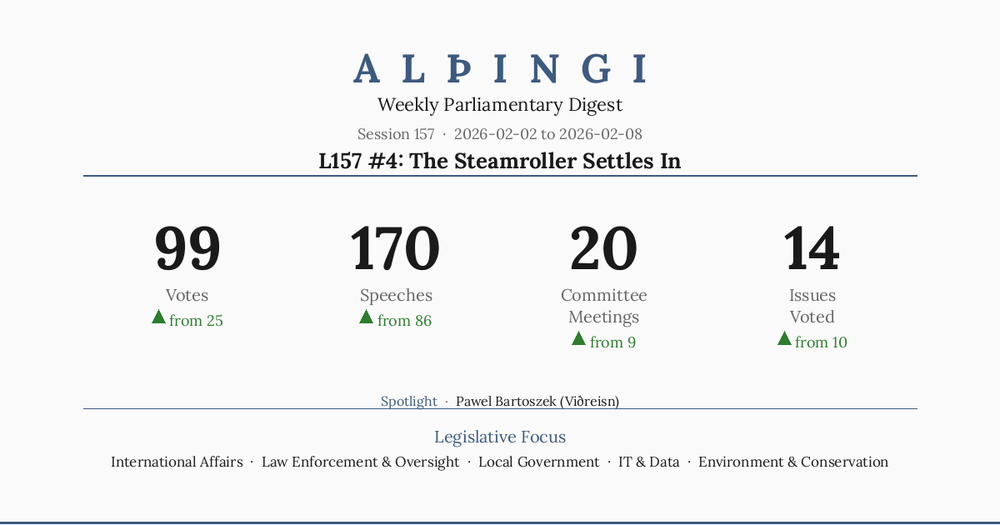
99
▲ from 25
Votes |
165
▲ from 91
Speeches |
20
▲ from 9
Committee Meetings |
14
▲ from 10
Issues Voted |
Legislative focus: International Affairs (15), Law Enforcement & Oversight (6), Local Government (4), IT & Data (4), Environment & Conservation (3)
Party Voting Patterns
Absence Rate
votes with tallies
Individual Votes
Most Words Spoken
Parliamentary Awards
Session 157 • Recognising the quirks and patterns of Althingi
The Awards Column
Fifteen MPs achieved a phantom score of 84 this week -- voting on nearly every division while delivering one speech or fewer. That is not an anomaly; it is the mathematical proof that the Althingi's plenary sessions have become, for a large plurality of members, a place where you press buttons and leave. The awards this week tell a story about the gap between those who showed up to argue and those who showed up to be counted.
The real surprise is not who spoke most but who spoke best. In a week dominated by formulaic annual reports from international delegations -- the kind of procedural debris that fills a chamber's calendar without filling its purpose -- two speeches broke through: one by an opposition backbencher wielding a minister's own words as a weapon, the other by a committee chair who turned a defence resolution into a meditation on what small nations owe to a world order they did not build.
Meanwhile, the Prime Minister repeated "halda kúrs" (stay the course) five times, the leader of Miðflokkurinn asked "Hvert er þetta plan?" (What is this plan?) nine times, and Dagbjört Hákonardóttir found seventeen separate uses for the word "tækifæri" (opportunities). Repetition in parliament is either a strategy or a symptom. This week offered generous helpings of both.
Mic Drop of the Week
The single best speech of the week — as judged by our parliamentary critic.
Þórdís Kolbrún Reykfjörð Gylfadóttir of Sjálfstæðisflokkurinn (Independence Party) delivered the week's defining speech -- and she did it while presenting a committee report, a format that usually guarantees nobody remembers what was said. Her presentation of the utanríkismálanefnd's report on Iceland's first defence and security policy transcended its procedural occasion. Where the resolution itself was necessarily diplomatic, Þórdís Kolbrún was philosophical: "En þá uppskrift völdum við ekki að öllu leyti sjálf. Hún var okkur gefin og við tókum þátt" -- "We did not entirely choose that recipe ourselves. It was given to us, and we participated." That sentence, applied to Iceland's place in the postwar international order, carried more analytical weight than most MPs manage in an entire session. She warned that clinging to old assumptions "is not just naive but genuinely dangerous" -- a line that reads differently depending on whether you think she was addressing Moscow or Washington. The speech passed 51-0, but it deserved to be heard rather than merely voted on.
“En við búum líka við skipan heimsmála sem byggist á hugmyndum sem eru Íslandi sérstaklega hagfelldar. Sú þróun sem varð eftir síðari heimsstyrjöld, að ríki séu nokkuð jöfn fyrir alþjóðakerfinu, óháð stærð og herstyrk, er afgerandi áhrifaþáttur um sögu okkar og farsæld. En þá uppskrift völdum við ekki að öllu leyti sjálf. Hún var okkur gefin og við tókum þátt. Ef hún breytist á verri veg þá mun það fela í sér meiri ógn en Ísland hefur staðið frammi fyrir í a.m.k. heila mannsævi.”
But we also live under a world order built on ideas that are especially favourable to Iceland. The postwar development — that states are roughly equal before the international system, regardless of size or military strength — is a decisive factor in our history and prosperity. But we did not entirely choose that recipe ourselves. It was given to us, and we participated. If it changes for the worse, it will pose a greater threat than Iceland has faced in at least a full human lifetime.
Þórdís Kolbrún Reykfjörð Gylfadóttir (Sjálfstæðisflokkurinn) — 1882 words on Þingsályktun um stefnu í varnar- og öryggismálum (2026-02-02).
In a week dominated by formulaic annual reports from international delegations, Þórdís Kolbrún delivered the only speech that transcended its procedural occasion. She constructed a philosophically rigorous argument about Iceland's existential dependence on a rules-based international order it did not create, warned that clinging to old assumptions 'is not just naive but genuinely dangerous,' and grounded the defense policy resolution in a broader meditation on what small nations owe — and are owed — in a world where the postwar consensus is fracturing.
Sharpest Question
The most incisive question or challenge posed in debate this week.
Sigmundur Davíð Gunnlaugsson of Miðflokkurinn has made a career of opposition theatre, but his question to Education Minister Inga Sæland was genuinely surgical. He catalogued her bold opening statements on school reform -- reading standards, standardised testing, classroom discipline -- then tracked how she progressively walked them back in subsequent media interviews. The kill shot: "Var hæstv. ráðherra kannski tekinn á teppið hjá hæstv. forsætisráðherra?" -- "Was the minister perhaps called to the carpet by the Prime Minister?" It forced Inga Sæland into an explicit denial of being disciplined by coalition leadership, which is precisely the kind of denial that confirms the suspicion. Sigmundur Davíð may overuse the formula, but this time the formula worked.
“Var hæstv. ráðherra kannski tekinn á teppið hjá hæstv. forsætisráðherra eftir fyrstu yfirlýsingarnar? Er það ástæðan fyrir því að hæstv. ráðherra dró í land með yfirlýsingar sínar um að menntakerfið væri hriplekt skip? Mun kerfið ráða för eða hæstv. ráðherra?”
Was the minister perhaps called to the carpet by the Prime Minister after her first statements? Is that the reason the minister walked back her declarations that the education system was a sinking ship? Will the system prevail, or the minister?
Sigmundur Davíð Gunnlaugsson (M) — on Staða og framtíð menntamála (2026-02-03).
Sigmundur Davíð delivered the week's most surgically precise political challenge, systematically cataloguing Education Minister Inga Sæland's bold initial statements on school reform — then tracking how she progressively retreated in media interviews. His question 'Was the minister perhaps called to the carpet by the PM?' struck at the credibility gap between rhetorical ambition and political reality, forcing the minister into a defensive response where she had to explicitly deny being disciplined by coalition leadership.
Broken Record Award
MPs who repeat themselves most — same catchphrases, recycled arguments, and recurring anecdotes across different speeches.
Prime Minister Kristrún Frostadóttir scored 0.92 on the broken record index -- the week's highest. "Við ætlum að halda kúrs" (We will stay the course) appeared five times across two economic speeches, joined by "Það liggur alveg fyrir" (It is perfectly clear) another five times and "fyrirsjáanleiki" (predictability) three times. The Prime Minister has a script and she is sticking to it -- "halda kúrs" is not just her policy, it is her entire rhetorical strategy.
Sigmundur Davíð Gunnlaugsson scored 0.78, deploying "plan" nine times in two speeches and "Hverjar verða afleiðingarnar" (What will the consequences be) seven times across three. The eternal opposition attack dog has exactly one mode: "Where is the plan?" He mocks the government for repeating "við ætlum" -- while his own speeches could be shuffled and no one would notice.
Dagbjört Hákonardóttir hit 0.72, with "tækifæri" appearing seventeen times across eight of her eleven speeches. She gave the Istanbul Convention speech three times in three slightly different wrappers -- "kynbundið ofbeldi" (gender-based violence) and "standa vörð" (stand guard) recurring like a liturgical response.
Ingibjörg Isaksen of Framsóknarflokkur (Progressive Party) scored 0.65 by finding the Finance Minister's weakness -- the word "óþægilegt" (uncomfortable) -- and weaponizing it, throwing it back five times in a single response. A disciplined opposition voice who turned the government's own rhetoric into a blunt instrument.
Infrastructure Minister Eyjólfur Ármannsson rounded out the list at 0.60. His coastal fishing formula -- boats times days times kilos -- was recited like a multiplication table. "Sáraeinfalt mál" (dead simple matter), he called it, and his rhetoric proved the point.
| Name | Speeches | Top Catchphrase | Uses |
|---|---|---|---|
| Kristrún Frostadóttir (Sf) | 8 | “Við ætlum að halda kúrs” | 5× |
| Sigmundur Davíð Gunnlaugsson (M) | 7 | “Við ætlum, við ætlum, við ætlum. En svo breytist …” | 2× |
| Dagbjört Hákonardóttir (Sf) | 11 | “tækifæri” | 17× |
| Ingibjörg Isaksen (Fr) | 5 | “barnafjölskyldur um hver einustu mánaðamót” | 4× |
| Eyjólfur Ármannsson (Ff) | 4 | “Við stefnum ótrauð á 48 dagana / fjölda báta og f…” | 4× |
1. Kristrún Frostadóttir, Prime Minister (Samfylkingin)
The Prime Minister has a script and she is sticking to it — "halda kúrs" is not just her policy, it is her entire rhetorical strategy. She could deliver her speeches with flash cards.
- “Við ætlum að halda kúrs” (5×) — "We will stay the course" — her signature line as Prime Minister, repeated 5 times across 2 speeches on economic policy.
- “Það liggur alveg fyrir” (5×) — "It is perfectly clear that..." — used as a rhetorical hammer 5 times across 3 different speeches to dismiss criticism.
- “hlaupa upp til handa og fóta út af stökum mælingum” (3×) — "Running around in panic over single measurements" — her go-to dismissal of inflation criticism, used across 2 separate debates.
- “Er þetta óþægilegt? Já.” (2×) — "Is this uncomfortable? Yes." — A rhetorical self-Q&A she deploys twice, turning critics concerns into a badge of honor.
- “fyrirsjáanleiki” (3×) — "Predictability" — her mantra word, used in 3 separate speeches as the promised benefit of staying on course.
2. Sigmundur Davíð Gunnlaugsson (Miðflokkurinn)
The eternal opposition attack dog has exactly one mode: "Where is the plan?" He mocks the government for repeating "við ætlum" — while his own speeches could be shuffled and no one would notice.
- “Við ætlum, við ætlum, við ætlum. En svo breytist ekki neitt.” (2×) — "We intend, we intend, we intend. But then nothing changes." — Devastating mockery of government rhetoric, while being somewhat repetitive himself.
- “Hvert er þetta plan? / Var kannski bara aldrei til neitt plan?” (9×) — "What is this plan?" — The word "plan" appears 9 times in just 2 speeches, always sarcastically questioning whether the government actually has one.
- “Hverjar verða afleiðingarnar” (7×) — "What will the consequences be" — his favorite rhetorical question, used 7 times across 3 economic speeches.
- “raunveruleikinn” (3×) — "The reality" — first "reality has appeared", then the government trying to "gaslýsa" (gaslight) after reality has come to light.
3. Dagbjört Hákonardóttir (Samfylkingin)
The "tækifæri" (opportunities) queen of Althingi — 17 uses in one week. She gave the Istanbul Convention speech three times in three slightly different wrappers.
- “tækifæri” (17×) — "Opportunities" — her absolute favorite word, appearing 17 times across 8 of her 11 speeches. Everything is a tækifæri.
- “Istanbúl-samningurinn / kynbundið ofbeldi / standa vörð / orð á blaði” (7×) — The Istanbul Convention speech — delivered not once but essentially three times. References appear 7 times, "kynbundið ofbeldi" 4 times.
- “vinaþjóð Eystrasaltsríkjanna” (2×) — The Baltic friendship story: Iceland recognizing Baltic independence after the fall of the Berlin Wall, and how Lithuanians remember it with gratitude.
Data sourced from Althingi Open Data (althingi.is). Generated 2026-02-08.
MP Spotlight
A deep dive into one parliamentarian each week

Pawel Bartoszek
Viðreisn
Born 1980-09-25
Stúdentspróf MR 2000. BS-próf í stærðfræði HÍ 2003. Meistarapróf í stærðfræði HÍ 2005.
|
94 speeches this session |
38,642 words total |
411 words avg per speech |
Pawel Bartoszek is the only member of the Althingi born in Poland, and he speaks about Iceland's place in the world with the clarity of someone who chose it rather than inherited it. The Viðreisn (Reform Party) MP for Reykjavíkurkjördæmi norður and chair of the utanríkismálanefnd (Foreign Affairs Committee) has delivered 94 speeches and 38,642 words across Session 157 -- making him the session's most prolific voice by a significant margin. This week alone he topped the charts with 15 speeches and 6,292 words, a volume that reflects not vanity but the sheer breadth of the foreign affairs portfolio in a session dominated by security realignment and trade disputes.
Born in Poznan in 1980 to an anthropologist mother and a linguist father, Bartoszek studied mathematics at the University of Iceland, earning both his bachelor's and master's degrees before turning to politics. He served as a member of Iceland's 2011 Constitutional Council, sat on the Reykjavik City Council from 2018 to 2025 -- including a stint as president of the city council -- and chaired the capital region's planning committee. He co-authored an Icelandic-Polish dictionary. This is not the biography of a political lifer; it is the biography of a polymath who wandered into parliament because the problems interested him.
Thematic Profile
Bartoszek's legislative portfolio in Session 157 orbits three poles: European integration, defence policy, and urban infrastructure. The connecting thread is institutional architecture -- how Iceland builds, maintains, and participates in the systems that keep a small nation viable.
On European affairs, he has been the chamber's most persistent advocate for the EEA agreement and its proper legal implementation. His September 2025 speech on bókun 35 (Protocol 35) of the EEA Agreement was a masterclass in constitutional lawyering delivered from the floor: he walked through the Supreme Court ruling that found Iceland's transposition of the protocol inadequate, quoted former minister Bjorn Bjarnason's support for the proposed fix, and dismantled Miðflokkurinn's argument that Parliament would never have ratified the EEA under these terms. "It is not possible to assert," he told the chamber, "that if our most capable experts at the time had concluded that the best and most correct way to implement Protocol 35 was in the manner now proposed, the Parliament would not have listened to those arguments."
On defence, Bartoszek was central to the cross-party working group that produced Iceland's first formal defence and security policy. His November 2025 speech framing the resolution drew on visits to NATO headquarters, meetings with SACEUR, and bilateral talks in Poland and Lithuania. But his most revealing contribution was a philosophical one: the argument that Iceland's defences cannot rest on the UN Charter alone, that "if the importance of international law diminishes, the path for states like ours is to strengthen participation in multilateral alliances -- alliances of politics, defence, and trade."
On infrastructure, he championed the borgarlína (bus rapid transit) system and a proposed cycling route between Reykjavik and Keflavik -- the latter combining transport policy, tourism strategy, and EuroVelo certification into a single legislative instrument. His October 2025 defence of the borgarlína against Miðflokkurinn's proposal to close road lanes as a protest experiment was characteristically blunt: "I would not find many traffic engineers who would recommend that the cheapest way to conduct a traffic experiment is to close lanes and make people angry."
The kilómetragjald (per-kilometre road charge) bill, which he shepherded through committee, revealed his technocratic side: a detailed walkthrough of fuel tax abolition mechanics, monitoring arrangements with the Competition Authority, and the interaction between road charges and the energy transition. He noted that the bill had been introduced twice before, in the 155th and 156th sessions, each time failing to pass -- and that the majority committee had made only minor adjustments. This is Bartoszek at his most characteristic: persistent, procedurally fluent, unbothered by the grind of resubmission.
Then there is the pet ownership debate. Yes, pet ownership. The fjöleignarhús (condominium) bill would loosen restrictions on keeping pets in apartment buildings, and Bartoszek delivered a 1,562-word speech that managed to be both philosophically grounded and practically detailed. He argued from the principle that property owners should generally be free to do as they wish within their walls, walked through the voting mechanics of housing associations that make it nearly impossible to overturn a pet ban, and addressed the counter-arguments about allergies with genuine respect. "Pets are a very large part of many people's lives," he told the chamber. "Many see their pets as part of their family, give them names, talk to them, give them Christmas presents, rejoice when they enter the home, and mourn them when they die." He then noted, with evident satisfaction, that this was the single issue most voters in his constituency wanted to know his position on -- more than EU membership, more than defence policy. The speech revealed something important about Bartoszek: he takes small-bore constituent concerns as seriously as geopolitical strategy, and he applies the same analytical rigour to both.
His February 2025 EFTA report to the chamber brought together the trade and diplomatic threads. He described his own advocacy against EU safeguard tariffs on ferrosilicon at forums in Warsaw, Copenhagen, Vilnius, and Istanbul, then delivered a self-deprecating but pointed summary: "I have not found any particular fear when raising these matters, nor did I feel I was apologising for the European Union." The line was directed at opposition critics who accused the government of timidity in defending Icelandic industry. Bartoszek's response was not to argue the point but to enumerate, meeting by meeting, exactly what he had done -- the diplomat's equivalent of showing your work.
Rhetorical DNA
Bartoszek's rhetorical signature is the structured argument delivered at conversational pace. Where other MPs build to a single rhetorical peak, he constructs layered cases -- premise, evidence, counterargument, rebuttal -- with the patience of someone who trusts the audience to follow. His speeches read like well-organized essays that happen to be spoken aloud. The mathematical training shows: he is precise about what he claims and careful about what he concedes.
His second distinctive quality is the deployment of personal experience as evidence rather than ornament. When he discusses urban planning, he cites his time chairing the capital region's planning committee. When he discusses OSCE or COSAC proceedings, he recounts specific conversations with specific delegates. The effect is credibility through specificity -- he does not assert expertise, he demonstrates it by showing you what he saw.
Favourite Catchphrases
| Phrase (Icelandic) | Translation | Usage |
|---|---|---|
| Mig langar að nefna | I would like to mention | Transitional phrase signalling a new evidence point, frequent across speeches (this session) |
| Það er ekki hægt að fullyrða | It is not possible to assert | His go-to phrase for dismantling opponents' claims, used in EEA and defence debates (this session) |
| Standa vörð um | To stand guard over / to protect | Applied to sovereignty, values, interests -- his default frame for Iceland's international obligations (this session) |
| Skoðum þetta betur | Let us examine this more closely | His invitation to the audience before methodical deconstruction, used in planning and EEA speeches (this session) |
| Ég kannast ekkert við það | I do not recognise that at all | His firmest rebuttal, deployed when opponents mischaracterise government positions, notably in the EU safeguards debate (this session) |
| Ég held að | I believe that | A hedge that precedes his strongest opinions -- when Bartoszek says "I believe," he means "I know" (this session) |
Emotional Register
The Patient Instructor. Bartoszek's default mode is explanatory authority. In the kilometre charge debate, the EEA protocol speech, and the planning law discussion, he walks through complex material with the calm of a lecturer who has taught this course before. He numbers his points, signals transitions, and trusts the logic to carry the argument. There is no urgency in the delivery -- the urgency is in the substance. This register works because he genuinely understands the technical material; it would be insufferable from someone bluffing.
The Sardonic Insider. When provoked, Bartoszek shifts to dry wit grounded in institutional knowledge. His dismissal of Miðflokkurinn's road-closure proposal -- comparing it to climate activists lying in traffic, then noting "this proposal bears much more the character of political activism, the purpose being to try to obstruct and hinder traffic in the city so that people turn against the idea of the borgarlína" -- was precise enough to sting without being cruel. He deploys this register sparingly, which is why it lands. His line about being willing to accept traffic cones bearing Miðflokkurinn MPs' faces was the week's most quotable parliamentary moment.
The Philosophical Europeanist. In his January 2026 speech on international affairs, Bartoszek shifted into a register rare in Icelandic politics: genuinely philosophical reflection on small-state vulnerability. "In a world where hard power alone prevails, we are in an inferior position," he told the chamber. "That is why active participation in international cooperation matters." This is not boilerplate -- it is the argument of someone who has studied how alliances work and worries about what happens when they stop working. The register carries weight because it is grounded in specific diplomatic encounters rather than abstract principle.
The Verdict
Pawel Bartoszek is the coalition's most intellectually serious backbencher, and possibly its most effective one. His chairmanship of the Foreign Affairs Committee gives him a platform; his mathematical precision gives him credibility; his personal history as an immigrant who chose Icelandic politics gives him a perspective that native-born MPs cannot replicate. He is the MP most likely to cite a specific Supreme Court ruling, a specific COSAC conversation, or a specific planning regulation -- and to be right about the details.
His weakness is visibility. Bartoszek is not a headline-maker. He does not deliver thundering floor speeches or pick public fights. His influence operates through committee work, diplomatic engagement, and the slow accumulation of institutional expertise. In a parliament that rewards charisma, he offers competence -- which is both his brand and his ceiling. He is the person you want writing your country's defence policy but not necessarily the person you want selling it on television. His 100% party loyalty score -- 595 votes with Viðreisn, zero dissents -- reinforces the point: this is a team player, not a rebel. In a coalition that depends on discipline, that is an asset. In a democracy that depends on challenge, it is worth noting.
His voting record also reveals what he is not: absent. With only 27 missed votes out of 622 this session, Bartoszek is one of the most consistently present MPs in the chamber. Compare that to Sjálfstæðisflokkurinn's aggregate 380 absences this week alone, or Framsóknarflokkur's 129. Showing up is the minimum requirement of democratic representation. Bartoszek meets it and then adds 39,000 words of substantive argument on top.
The 94 speeches this session tell a story of range: from constitutional law to cycling infrastructure, from EU safeguard tariffs on ferrosilicon to pet ownership in apartment buildings. That breadth is unusual. Most MPs specialise or grandstand. Bartoszek does neither. He studies the material, forms a position, and explains it clearly -- then moves to the next file. The OSCE report, the EFTA delegation speech, the defence policy second reading: each one landed in the same week, each one prepared with the same methodical thoroughness. He is not performing versatility; he is simply working the portfolio.
The deeper question is whether Bartoszek's brand of politics -- technocratic, internationalist, institution-building -- has a future in an era that rewards populist simplicity. His defence of the EEA agreement is legally rigorous but emotionally restrained. His advocacy for the borgarlína is evidence-based but lacks the visceral appeal of Miðflokkurinn's "just try it and see" populism. In a parliament where Sigmundur Davíð Gunnlaugsson can land a devastating blow with a single sarcastic question, Bartoszek's carefully constructed multi-paragraph rebuttals risk being admired rather than remembered. But admiration compounds. The mathematician in him would appreciate that.
Key Legislation & Votes
Legislation Advancing
Legislation Advancing
| Issue | Title | Stage | Vote |
|---|---|---|---|
| #155 | almannatryggingar | In committee | |
| #219 | fullgilding samningsins um loftslagsbreytingar, viðskipti og sjálfbærni | Enacted | Resolution (final vote) — samþykkt (43/7) |
| #330 | skipalög | Awaiting 2nd reading | Bill advances |
| #400 | kosningalög, sveitarstjórnarlög og lögheimili og aðsetur | Awaiting 2nd reading | Bill advances |
| #115 | stefna í neytendamálum til ársins 2030 | Enacted | Resolution (final vote) — samþykkt (49/0) |
| #90 | framkvæmdaáætlun í kynjajafnréttismálum fyrir árin 2026--2029 | Enacted | Resolution (final vote) — samþykkt (36/0) |
Stage key: 1st reading • In committee • 2nd reading • 3rd reading • Enacted
Get Þingfréttir by email
Weekly parliamentary digest — straight to your inbox every Sunday.
Subscribe