L157 #3: The Silent Gavel
Editorial: The Week in Parliament
One MP produced nearly a quarter of all the words spoken in parliament last week. Víðir Reynisson of Samfylkingin (the Social Democrats) delivered five speeches totalling 6,365 words — more than the next two speakers combined — while the chamber as a whole managed just 91 speeches and 26,139 words, an 80% drop from the previous week's 450-speech marathon. After days of transport-plan theatrics, the Althingi did not rest so much as collapse.
What business survived the lull concentrated on a single remarkable Thursday. Parliament pushed veiting ríkisborgararéttar (conferral of citizenship) through all three readings in one sitting, clearing two separate afbrigði (derogation) votes to waive the mandatory intervals between stages. The final tally — 38 in favour, zero against, ten abstentions — tells the story of a bill whose controversy was procedural, not substantive. Miðflokkurinn (the Centre Party) abstained en bloc rather than oppose, a studied gesture of withholding legitimacy without recording dissent. Not a single "nei" was cast across all 25 divisions of the week. When the opposition's sharpest weapon is strategic absence, the coalition is operating in a different league.
The real confrontation was verbal, not legislative. In the allsherjar- og menntamálanefnd (General Affairs and Education Committee), Víðir presented the majority opinion on a significant overhaul of the Foreigners Act — proposing that Iceland join every other Nordic country in permitting revocation of international protection when the recipient commits serious crimes or threatens national security. Jens Garðar Helgason of Sjálfstæðisflokkurinn (the Independence Party) seized the opening with four speeches painting Scandinavian dystopia: gang violence in Sweden, loss of control in Germany, Danish colleagues warning that Iceland can still "snúa taflinu við" (turn the board). It was the week's sharpest ideological divide, fought entirely in committee-report rhetoric rather than floor drama.
The parallel fiscal skirmish was equally revealing. Daði Már Kristófersson, Viðreisn's (the Reform Party's) Finance Minister, logged eight speeches defending economic policy against Sigmundur Davíð Gunnlaugsson, who cast the government as áhorfendur (spectators) watching their own plan fail. Sigríður Á. Andersen, also from Miðflokkurinn, pressed Daði Már on a 32% carbon tax hike by quoting the government's own budget documents until the Minister resorted to his signature disclaimer: "Ég botna ekkert í þessu" — "I cannot fathom this." A finance minister who publicly professes bafflement at the opposition's questions is betting heavily on the audience siding with his exasperation over their argument. Meanwhile, the defence and security policy resolution was adopted, the gender equality action plan for 2026-2029 advanced through committee, and a resolution supporting Greenland's right to self-determination was tabled — a quiet diplomatic signal amid the noise. Fifty-five public submissions landed across seven committees, with efnahags- og viðskiptanefnd (Economic Affairs Committee) absorbing sixteen alone. Sjálfstæðisflokkurinn led all parties with 35 absences; Kristrún Frostadóttir's coalition held together without a crack.
The verdict on this parliament's quietest week is simple: a government with uncontested procedural control has begun clearing its backlog at speed, using coalition discipline and derogation votes to compress timelines that exist for good institutional reasons. That efficiency is impressive. It is also a warning. When a citizenship bill travels from introduction to law before lunch and the only opposition response is to leave the chamber, parliament is functioning — but the institutional friction that forces better legislation is being traded for velocity. Efficient governance and accountable governance are not always the same thing.
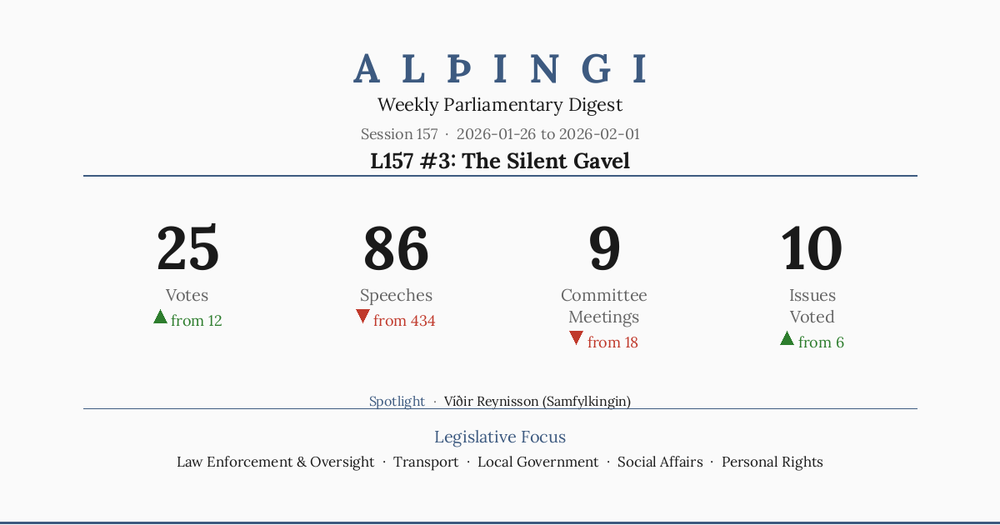
Week at a Glance
|
25
▲ from 12
Votes |
91
▼ from 450
Speeches |
9
▼ from 18
Committee Meetings |
10
▲ from 6
Issues Voted |
Legislative focus: Law Enforcement & Oversight (5), Transport (3), Local Government (3), Social Affairs (3), Personal Rights (3)
Party Voting Patterns
Absence Rate
votes with tallies
Individual Votes
Most Words Spoken
Parliamentary Awards
Session 157 • Recognising the quirks and patterns of Althingi
The Awards Column
The most revealing finding this week is not what parliament debated but how its heaviest hitters talked when they thought the audience had thinned. With only 86 speeches across the entire chamber, the Broken Records data captures an unusually concentrated sample: six MPs account for nearly half the week's total word count, and their rhetorical habits are on full display. The citizenship bill passed without a single opposing vote. The defence policy resolution cleared committee. The gender equality action plan advanced. None of this generated the kind of friction that produces memorable parliamentary combat — which is precisely why the repetition patterns are so instructive. When politicians are not fighting over outcomes, they reveal the verbal architecture they default to under low pressure.
What that architecture shows is a parliament divided not by policy but by rhetorical strategy. The coalition's top speakers — Kristrún Frostadóttir, Daði Már Kristófersson, and Víðir Reynisson — repeat themselves for disciplinary reasons: to hold a message, to teach a concept, to present committee orthodoxy. The opposition's leading voices — Sigmundur Davíð Gunnlaugsson, Jens Garðar Helgason, and Sigríður Á. Andersen — repeat themselves for prosecutorial reasons: to trap, to warn, to quote the government's own words back at them. Same parliament, same week, entirely different uses of the same rhetorical device.
Broken Record Award
MPs who repeat themselves most — same catchphrases, recycled arguments, and recurring anecdotes across different speeches.
Kristrún Frostadóttir's score of 0.88 — the week's highest — reflects a Prime Minister running on two slogans and a fiscal metric. Her "halda kúrs" (stay the course) mantra appeared six times across economic policy, citizenship, and budget debates, while "allir þurfa að líta inn á við" (everyone must look inward) served as her all-purpose justification for austerity. The fiscal touchstone of "hallalaus fjárlög" (a balanced budget) completed the triad. Kristrún's repetition is not a verbal tic — it is siege warfare, the same message delivered until it becomes the only frame available for discussing her government's economic record.
Jens Garðar Helgason scored 0.72 with a repertoire that reads like a nationalist alarm system: Danish colleagues warning that Iceland can still avoid the Nordic path, Sweden's gang violence invoked as prophecy, and the closing formula "vernda íslenska borgara og standa vörð um íslenska menningu og tungu" (protect Icelandic citizens and guard Icelandic culture and language) deployed as moral imperative. His repetition comes from a different place than the Prime Minister's — where Kristrún repeats to defend, Jens Garðar repeats to escalate, each iteration raising the stakes of inaction.
Sigmundur Davíð Gunnlaugsson (0.68) built his entire week around a single metaphor: the government as áhorfendur (spectators) watching their own economic programme fail. The opposition elder's rhetorical method is the accusatory loop — "hvernig ætlar ráðherra að bregðast við?" (how does the minister intend to respond?) asked with the persistence of a prosecutor who already knows the witness cannot answer. Sigríður Á. Andersen (0.65) ran a complementary operation, quoting the Finance Ministry's own budget justification for a 32% carbon tax hike and demanding to know whether car owners could trust that further increases were not coming. Her method is forensic where Sigmundur Davíð's is theatrical: she traps ministers in their own published documents.
The Finance Minister himself, Daði Már Kristófersson, earned his 0.42 score almost entirely from one exasperated economics lecture he could not stop delivering: that subsidising prices to lower inflation measurements would paradoxically raise inflation expectations. When he told parliament "Ég botna ekkert í þessu" — "I cannot fathom this" — three times in a single session, the repetition had the quality of a university lecturer who has realised the class is not following the syllabus and has decided that saying it louder will help. Víðir Reynisson's 0.35 — the lowest score — confirmed what the spotlight profile reveals: a technocrat who recycles procedural language but varies substantive content, the committee chairman as institutional constant rather than rhetorical repeater.
| Name | Speeches | Top Catchphrase | Uses |
|---|---|---|---|
| Kristrún Frostadóttir (Sf) | 10 | “Við erum að halda okkur við planið / ekki að gefa…” | 6× |
| Jens Garðar Helgason (Sj) | 4 | “ferð Brynjars Níelssonar og Jóns Gunnarssonar til…” | 2× |
| Sigmundur Davíð Gunnlaugsson (M) | 4 | “áhorfandi / áhorfendur að atburðarásinni / utanað…” | 4× |
| Sigríður Á. Andersen (M) | 4 | “kolefnisgjald hækkað um 32% / 100% hækkun á einu ári” | 3× |
| Daði Már Kristófersson (V) | 8 | “niðurgreiðsla verðlags / niðurgreiða til að falsa…” | 5× |
1. Kristrún Frostadóttir, Prime Minister (Samfylkingin)
The Prime Minister hammers two defiant slogans across every debate: we are not giving up the plan, and others must look inward too.
- “Við erum að halda okkur við planið / ekki að gefast upp / ekki að skipta um kúrs” (6×) — Deployed defensively whenever questioned about inflation, economic outcomes, or policy challenges — her signature stay-the-course mantra appears in economic policy, citizenship, and budget debates.
- “allir þurfa að líta inn á við” (4×) — Used to justify austerity measures (cutting presidential allowances, public sector constraints) and deflect criticism — frames sacrifice as collective duty.
- “Við erum að skapa aðstæður til / leggja grunninn að” (5×) — Forward-looking framing that shifts focus from present problems to future outcomes (lowering interest rates, strengthening infrastructure) — appears when defending policies under attack.
- “loka fjárlagagatinu / hallalausum fjárlögum” (4×) — Repeated touchstone for fiscal discipline — her go-to metric for successful governance, mentioned in economic policy, rural development, and presidential salary debates.
- “tölur / verðbólga sem aldrei sáust á síðasta kjörtímabili” (3×) — Comparative defense mechanism contrasting current economic indicators with previous government record — used to contextualize disappointing inflation numbers.
2. Jens Garðar Helgason (Sjálfstæðisflokkur)
A nationalist firebrand who weaponizes Nordic dystopia and quotes foreign leaders to demand Iceland slam the door before it is too late.
- “ferð Brynjars Níelssonar og Jóns Gunnarssonar til Danmerkur / danskir kollegar sögðu að Ísland gæti snúið taflinu við” (2×) — Recurring reference to a Danish trip by fellow MPs where officials warned Iceland could avoid the Nordic migration crisis — used to legitimize hardline policy.
- “Við viljum ekki fara þangað / eigum enn tækifæri til að fara ekki á þennan stað” (3×) — Apocalyptic warning about becoming like Sweden/Germany — fear-based rhetoric positioning Iceland as still saveable if action is taken now.
- “læra af reynslu annarra / sjáum stöðuna í Svíþjóð/Þýskalandi” (3×) — Frames foreign examples (gang violence in Sweden, loss of control in Germany) as cautionary tales — used across immigration and border security speeches.
- “vernda íslenska borgara og standa vörð um íslenska menningu og tungu” (2×) — Nationalist closing formula invoking parliamentary duty to protect Icelandic culture — appears as moral imperative in immigration debates.
3. Sigmundur Davíð Gunnlaugsson (Miðflokkurinn)
The opposition elder paints the government as detached spectators to their own disaster, asking the same accusatory question in loop: will you finally act?
- “áhorfandi / áhorfendur að atburðarásinni / utanaðkomandi áhorfandi” (4×) — Central metaphor casting the government as passive observers rather than actors — used in economic policy debates and presidential salary discussions to question their agency.
- “varað við / varaði stjórnarandstaðan við / réttust aðvaranirnar” (3×) — Frames current problems (inflation spike) as vindication of opposition warnings before Christmas — repeated I-told-you-so structure positioning opposition as prescient.
- “hvernig ætlar ráðherra að bregðast við? / hvað verður ofan á?” (3×) — Signature question formula demanding concrete response after identifying government failure — appears in economic policy and social security debates.
Data sourced from Althingi Open Data (althingi.is). Generated 2026-02-01.
MP Spotlight
A deep dive into one parliamentarian each week

Víðir Reynisson
Samfylkingin
Born 1967-04-22
Húsasmiður frá Iðnskólanum í Reykjavík 1991. Lögreglumaður frá Lögregluskóla ríkisins 2006.
|
44 speeches this session |
22,440 words total |
510 words avg per speech |
Before Víðir Reynisson became the chairman of the allsherjar- og menntamálanefnd (General Affairs and Education Committee), he spent a quarter-century preparing for emergencies that never had the courtesy to arrive one at a time. Born in the Westman Islands in 1967 — the son of a school principal and a factory worker — he trained as a carpenter at Iðnskólinn í Reykjavík, spent nine years building houses, and then retrained as a police officer in 2006 while already running the country's civil protection division. The CV reads like a life lived in escalating concentric circles of responsibility: project manager for the National Civil Defence Agency (2000), department head at the National Commissioner of Police (2006), director of civil protection for the South Iceland police district (2015), safety officer for the Icelandic Football Association for twenty-one years, member of NATO's Civil Emergency Planning Committee for over a decade, and finally head of national civil protection operations during the pandemic (2020-2024). He arrived in the Althingi in 2024 as the MP for Suðurkjördæmi (South Constituency) with the quiet authority of someone who has already managed a country through worse crises than a parliamentary debate.
That biography — carpenter, policeman, crisis manager, parliamentarian — is the skeleton key to his committee work. Víðir runs parliament's most eclectic legislative portfolio like a traffic controller at a policy intersection. Immigration law, media subsidies, secondary education reform, gender equality action plans, consumer protection strategy, the consolidation of district commissioners, recognition of foreign professional qualifications, and the granting of Icelandic citizenship: all of it passes through his committee, and in Session 157, all of it has passed through his mouth. Forty-four speeches and nearly 22,000 words across the session make him not a dominant floor presence in raw volume, but an extraordinarily broad one. Where some MPs hammer a single nail for six months, Víðir hammers thirty different nails in carefully timed intervals.
Thematic Profile
His nine speeches on fjölmiðlar (media) constitute his single largest thematic cluster — a sustained engagement across September and October defending the government's extension of subsidies for private news media. He framed the issue not as a matter of corporate welfare but as a question of democratic infrastructure, arguing that independent journalism serves as a bulwark against the upplýsingaóreiðu (information chaos) of the social media age. Rural media outlets, he repeatedly emphasised, sometimes depend on these subsidies for an entire staff position. The speech was simultaneously a committee report and a political manifesto for press pluralism in a country small enough that the loss of a single regional newsroom alters the democratic landscape.
The immigration law speech of 28 January — his masterwork at 3,107 words — covered the proposed amendments to the Foreigners Act allowing revocation of international protection for those convicted of serious crimes. It is the speech of a man who served on NATO and EU civil emergency committees for over a decade and who wants the parliamentary record to show every angle has been covered. He mapped each provision against the Icelandic constitution, the European Convention on Human Rights, and the 1951 Refugee Convention, layering them like geological strata. He positioned Iceland as the last Nordic country without the power to revoke protection in cases of serious criminality — a framing that simultaneously legitimised the bill and constrained its scope. The speech contained a key legal backstop: the non-refoulement principle remains absolute, meaning no one can be deported to a country where their life or freedom is at risk, regardless of their criminal record. The balance was deliberate. Víðir was building a structure that could withstand both the opposition's liberalism and Jens Garðar Helgason's Nordic-dystopia rhetoric.
His policy portfolio defies easy ideological categorisation. He is a Samfylkingin MP — centre-left, social democratic — but his floor work is primarily institutional rather than ideological. He presents committee majority opinions built through cross-party negotiation. He defends media subsidies to protect rural journalism and the Icelandic language. He argues for gender equality action plans with 40 discrete actions, student loan reform at Menntasjóður námsmanna, and humane immigration policy. But he also presents tight, lawyerly restrictions on international protection for convicted criminals. The through-line is not left-wing conviction but committee chairmanship as craft: whatever the committee has agreed, Víðir will present it with forensic thoroughness.
The January 29 speech on sýslumenn (district commissioners) revealed a different facet: the man from the Westman Islands defending rural Iceland against the gravitational pull of Reykjavík. He proposed legislating a requirement that at least 65% of jobs in the merged commissioner's office remain on landsbyggðin (the countryside) — an unusually concrete floor for a government that often speaks in aspirational generalities about regional development. The ferryboat speech on vegalögum (road legislation), brief as it was, carried the authenticity of someone who watched the replacement ferry Baldur fail to reach Vestmannaeyjar the previous week. For Víðir, transport infrastructure is not an abstract policy question. It is the thing that determines whether his constituents can get home.
Rhetorical DNA
Víðir speaks in two fundamentally different registers, and the gap between them tells you everything about his political method. In presenting mode — the committee report speeches that account for the majority of his word count — he is a legislative cartographer. The immigration law speech proceeds through each article in sequence, maps each provision against international treaties and EU regulations, and anticipates objections with pre-loaded counter-arguments. The structure is invariable: context, legal framework, committee deliberation, submissions received, majority position, amendments, closing. It is not oratory. It is architecture. Every paragraph is load-bearing. His signature technique is the triple-layer citation — the Icelandic constitution, the European Convention, the Refugee Convention — stacked not for rhetorical effect but to make the committee's position legally impregnable.
In debate mode — the roughly twenty andsvar (replies) that make up nearly half his speech count — a different Víðir emerges. The sentences shorten, the citations evaporate, and the committee chairman gives way to a politician who knows how to frame a question. His favourite technique is the polite false binary: "Eigum við að sleppa þessu, taka þetta upp á næsta ári eða eigum við að klára þetta mál núna?" — asked three times in a single media debate, each time of a different opposition MP. The question sounds open-ended. It is not. His debate style carries no aggression, only a slightly bemused determination to keep the conversation on track — the tone of a man who once explained volcanic evacuation protocols to frightened citizens and has learned that the only thing more dangerous than panic is confusion.
Favourite Catchphrases
| Phrase (Icelandic) | Translation | Usage |
|---|---|---|
| "Gögn málsins eru aðgengileg undir málinu á vef Alþingis" | "The case documents are accessible on the Althingi website" | Ritualistic procedural anchor in nearly every committee report (this session) — the paper trail exists and he has read all of it. |
| "Meiri hluti allsherjar- og menntamálanefndar árétta" | "The majority of the General Affairs Committee emphasises" | Standard committee-opinion opener, used to launder personal analysis into collective authority (this session). |
| "Þess vegna legg ég áherslu á" | "Therefore I emphasise" | Transition from exposition to advocacy — always preceded by evidence, making the conclusion feel inevitable (this session). |
| "Eigum við að klára þetta mál núna?" | "Should we finish this matter now?" | False-binary question that frames inaction as the opponent's burden to justify (this session). |
| "Mikilvægt er að" | "It is important that" | Default modifier — everything is "important," never "critical" or "urgent." Deliberate temperature control (this session). |
| "Öryggisáttavitinn" | "The security compass" | Personal metaphor for integrated national security, drawn from two decades of civil protection work (this session). |
Emotional Register
Institutional authority is his home frequency. The committee report speeches are delivered in a tone of studied impartiality — the chairman presenting not his views but the committee's views, even when those views are clearly his own. "Meiri hlutinn" (the majority) is invoked so persistently that it functions as a rhetorical shield: you are not disagreeing with Víðir Reynisson; you are disagreeing with the considered judgement of the General Affairs and Education Committee. This register produces his most effective work — the immigration law speech is a masterclass in making complex legal arguments sound like the inevitable conclusion of a fair process — but it also produces his least memorable moments. Measured authority is difficult to quote. It is difficult to remember. It is, however, very difficult to argue with.
Quiet moral conviction surfaces when the subject moves from procedure to people. The shift is subtle but unmistakable. In the immigration debate, when discussing those who cannot be deported but cannot be granted full protection, the language warms: "fólk í viðkvæmri stöðu" (people in a vulnerable position) carries a frequency that betrays genuine concern beneath the legal framework. In the speech on EU steel tariffs and the Elkem ferrosilicon plant at Grundartangi, his voice finds its most passionate register: "Þarna var ekki verið að verja línur í bókhaldi. Þarna var verið að verja lífsviðurværi fólks" — "We were not defending lines in a ledger. We were defending people's livelihoods." This is the social democrat — the son of a Vestmannaeyjar factory worker — breaking through the committee chairman's armour, and it is Víðir at his most persuasive. The same warmth appears in the gender equality action plan speech when he discusses the conditions of women in prison, quoting research on childhood trauma prevalence among Icelandic inmates with the care of someone who has seen the consequences of failed institutional responses firsthand.
Pedagogical patience emerges in debate, particularly when engaging opposition MPs who he believes are conflating distinct issues. His media-debate technique — posing the same binary question to three different MPs across an evening session — is delivered with the genial persistence of a teacher who knows the correct answer and is confident that repetition will eventually produce it. There is no contempt in this register, no condescension — just the slightly bemused determination of a crisis manager who has learned that people make better decisions when they are given fewer options, presented more clearly, repeated more often. In the Menntasjóður námsmanna (Student Loan Fund) debate, he walked parliament through the mechanics of per-semester loan forgiveness versus end-of-degree forgiveness with the patience of someone explaining a volcanic evacuation route for the third time.
The Verdict
Víðir Reynisson is the most quietly effective committee chairman on the floor of the 157th Althingi. His 44 speeches span more distinct policy areas than those of any other MP with a comparable speech count, yet each one demonstrates the same forensic preparation — the same triple-layer legal citations, the same procedural scaffolding, the same deliberate transition from evidence to conclusion. The immigration law speech would be a creditable piece of legal scholarship. The media subsidies debate shows a skilled questioner who can steer a conversation without appearing to dominate it. The Elkem speech reveals a politician capable of genuine passion when livelihoods, rather than procedures, are at stake.
His weakness is invisibility. The institutional voice that makes him so effective in committee makes him almost impossible to quote in a headline. He does not produce memorable phrases; he produces well-built arguments. He does not create parliamentary drama; he resolves it into majority opinions. His 98.6% party loyalty score — with all eight dissents being announced absences on a single bill about the UN disability convention — confirms a man who works within the system rather than against it.
But in a parliament that often confuses volume with substance, Víðir offers something increasingly rare: the thoroughly prepared speech, the properly cited source, the question asked not for theatrical effect but to actually extract an answer. He came to politics late, after decades of building houses and managing crises. The tools change across a career — the saw, the radio, the gavel — but the method does not: measure twice, cut once, and make sure the structure can bear the weight. The Althingi has flashier performers. It does not have many who leave the parliamentary record in better condition than they found it.
Key Legislation & Votes
Legislation Advancing
Legislation Advancing
| Issue | Title | Stage | Vote |
|---|---|---|---|
| #401 | stuðningur við rétt grænlensku þjóðarinnar til sjálfsákvörðunar | ||
| #400 | kosningalög, sveitarstjórnarlög og lögheimili og aðsetur | ||
| #398 | veiting ríkisborgararéttar | Enacted | Bill advances to 3rd reading — samþykkt (38/0) |
| #314 | laun forseta Íslands og Stjórnarráð Íslands | Awaiting 2nd reading | Bill advances |
| #329 | framkvæmdir við þjóðveginn yfir Öxi hafnar | Awaiting 2nd reading | Resolution advances |
| #312 | atvinnuleysistryggingar og vinnumarkaðsaðgerðir | Awaiting 2nd reading | Bill advances |
| #311 | réttindavernd fatlaðs fólks | Awaiting 2nd reading | Bill advances |
Stage key: 1st reading • In committee • 2nd reading • 3rd reading • Enacted
Get Þingfréttir by email
Weekly parliamentary digest — straight to your inbox every Sunday.
Subscribe