L157 #2: Roads and Realignment
Editorial: The Week in Parliament
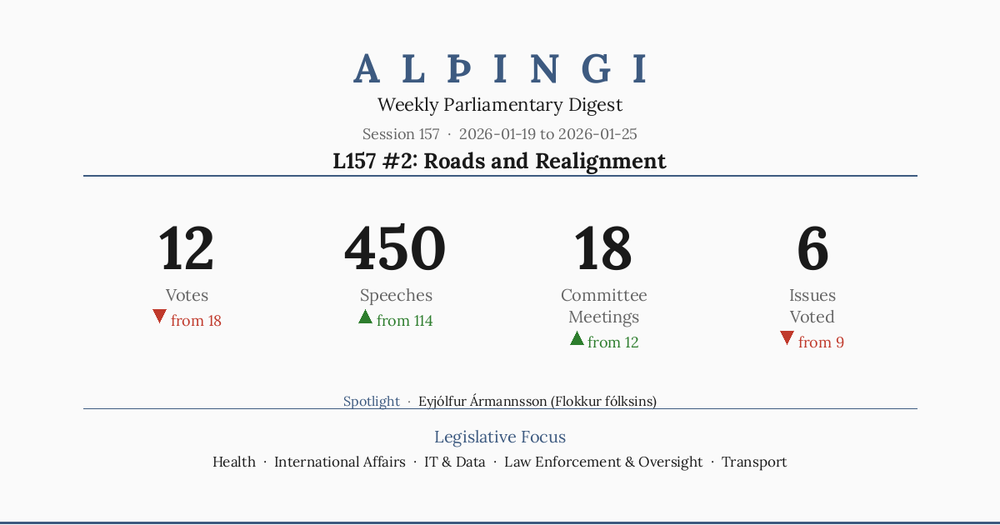
Four hundred and fifty speeches in five days, up from 122 the week before — a 269% surge — while votes actually dropped from 18 to 12. The Althingi talked nearly four times as much and decided a third less. That is what happens when a government lays a trillion-krona infrastructure plan and a geopolitical thesis on the table in the same week, and the opposition decides both deserve the full treatment.
Monday and Tuesday belonged to the samgönguáætlun (transport plan) for 2026--2040, issue #322, presented by Infrastructure Minister Eyjólfur Ármannsson of Flokkur fólksins (People's Party). The headline numbers were designed to impress: over 1,000 billion ISK across 15 years, road maintenance nearly doubling from 12--13 billion to 20 billion annually, and a new innviðafélag (infrastructure company) to break a five-year drought in tunnel construction. Sjálfstaeðisflokkurinn (Independence Party) responded not with outrage but with forensic patience. Njáll Trausti Friðbertsson read page 16 of the plan aloud — the page where the fine print says funding depends on annual budget reviews — and did so six times across the week, until the caveat was louder than the promise. Tómas Þór Þórðarson systematically dismantled the word "fullfjármögnuð" (fully funded) until it sounded less like policy and more like marketing. The opposition's core objection is hard to dismiss: the infrastructure company that is supposed to fund the tunnels does not yet have enabling legislation. A fully funded plan whose funding mechanism does not legally exist is, at best, an ambitious promissory note.
Thursday pivoted to geopolitics. Foreign Minister Þorgerður Katrín Gunnarsdóttir of Viðreisn (Reform Party) delivered a 2,929-word oral report on international affairs — issue #377 — that amounted to a doctrinal reset. She traced the arc from post-WWII institution-building through Trump's Greenland threats, Russia's war in Ukraine, and China's expanding reach, then landed on a conclusion that will reverberate: the EEA agreement is an "absolute minimum," and Iceland should consider EU membership talks. Her sharpest line — that it would be "óþolandi" (intolerable) for small nations to "wait meekly for crumbs to fall from the table of the powerful" — was not diplomatic wallpaper. It was a Foreign Minister telling parliament that strategic ambiguity has an expiry date. Sigurður Ingi Jóhannsson of Framsóknarflokkurinn (Progressive Party), a former Prime Minister, fired back with the week's most incisive counterargument: Iceland has been sovereign since 1918 without joining a trade bloc, and choosing to join one during a period of global fragmentation might be panic dressed as strategy.
Five bills cleared first reading on Wednesday evening — medical devices, patient rights, health insurance and fertility treatments, public support for science and innovation, and territorial waters — all advancing without contested votes. The allsherjar- og menntamálanefnd (Constitutional and Education Committee) led the committee calendar with three meetings and seven public submissions, while 18 committee meetings across parliament kept the legislative plumbing functional beneath the rhetorical flood.
The week's deeper pattern is the gap between diagnosis and mechanism. Eyjólfur has a trillion-krona transport vision and no infrastructure company bill. Þorgerður Katrín has a geopolitical thesis and no EU referendum date. Both are asking parliament to trust the direction before the vehicle is built. The opposition, armed with page 16 and a century of sovereignty, is asking to see the engineering drawings first. On the evidence of this week, both sides are right — which is precisely the kind of impasse that produces 450 speeches and 12 procedural votes.
Week at a Glance
|
12
▼ from 18
Votes |
450
▲ from 122
Speeches |
18
▲ from 12
Committee Meetings |
6
▼ from 9
Issues Voted |
Legislative focus: Health (3), International Affairs (3), IT & Data (2), Law Enforcement & Oversight (2), Transport (2)
Parliamentary Awards
Session 157 • Recognising the quirks and patterns of Althingi
The Awards Column
The Foreign Minister won the week's best speech award for calling on Iceland to rethink its entire geopolitical alignment — and the sharpest question came from a former Prime Minister who asked whether that rethinking was courage or panic. Meanwhile, six MPs spent the week saying the same things so many times that the stenographers could have worked from templates. When parliament produces 434 speeches in five days, repetition is not a bug but a structural feature.
What made this week unusual was the intensity of the echo chamber. The transport plan debate created a feedback loop: the minister said "fullfjármögnuð" (fully funded), the opposition said "prove it," and then both sides repeated the exchange thirty-seven times with minor variations. The foreign affairs debate had its own loop — "ég treysti þjóðinni" (I trust the nation) versus "we've been sovereign since 1918" — but with higher stakes and sharper prose. The awards this week are less about individual performances and more about what happens when an entire parliament locks onto two issues and will not let go.
Mic Drop of the Week
The single best speech of the week — as judged by our parliamentary critic.
Þorgerður Katrín Gunnarsdóttir's oral report on international affairs was not a ministerial update — it was a 2,929-word argument that Iceland's post-war foreign policy assumptions are obsolete. The Foreign Minister traced the collapse of the rules-based international order from the founding of NATO through Russia's invasion of Ukraine, Trump's Greenland threats, and China's expanding influence, then arrived at a conclusion no Icelandic foreign minister has stated so directly from the parliamentary podium: the EEA agreement is an "absolute minimum," and EU membership talks should be on the table. Her most devastating passage — "Það væri óþolandi fyrir okkur Íslendinga... ef við ætluðum að keppa um hylli hinna sterku og síðan bíða þæg og róleg eftir því að molar af gnægtarborði þeirra féllu af og til" (It would be intolerable if we were to compete for the favour of the powerful and then wait meekly for crumbs to fall from their table) — was not diplomatic boilerplate but a direct challenge to the Eurosceptic consensus that has governed Icelandic foreign policy for decades. In a week where most speeches repeated themselves, this one changed the terms of the debate.
“Það væri óþolandi fyrir okkur Íslendinga og ekki boðleg staða ef við, smáríkin eða meðalstóru ríkin, ætluðum að keppa um hylli hinna sterku og síðan bíða þæg og róleg eftir því að molar af gnægtarborði þeirra féllu af og til til litlu og meðalstóru ríkjanna.”
It would be intolerable for us Icelanders if we, the small or medium-sized nations, were to compete for the favour of the powerful and then wait meekly for crumbs to fall from their table of plenty.
Þorgerður Katrín Gunnarsdóttir (V), Foreign Affairs Minister — 2929 words on Munnleg skýrsla utanríkisráðherra um stöðu og horfur í alþjóðamálum (2026-01-22).
The Foreign Minister delivered a 2,900-word reframing of Iceland's geopolitical stance — from the post-WWII order's collapse through Trump's Greenland threats to an explicit call for an EU membership referendum. In a week of speeches about international instability, this was the only one that announced Iceland would fundamentally rethink its alliances in response.
Sharpest Question
The most incisive question or challenge posed in debate this week.
Sigurður Ingi Jóhannsson, the former Prime Minister and Framsóknarflokkurinn (Progressive Party) veteran, delivered the kind of challenge that is hardest to answer because it accepts the premise and inverts the conclusion. In an 1,844-word speech during the same foreign affairs debate, he granted that the world is fragmenting into trade blocs — and then asked why Iceland would choose this exact moment to join one. "Ég er stórkostlegur efasemdarmaður þess að Ísland eigi að segja: Við ætlum að velja að verða hluti af einhverju viðskiptabandalagi. Við gerðum það ekki fram að þessum tíma, meðan við vorum fullvalda frá 1918" (I am profoundly sceptical that Iceland should declare it will become part of some trade bloc. We didn't do that during all the time we've been sovereign since 1918). The real blade was his proposed Greenland sovereignty resolution, which forced MPs to confront an uncomfortable contradiction: you cannot champion Greenlandic self-determination on Thursday and advocate surrendering Icelandic sovereignty to Brussels on Friday. Whether or not you agree with his conclusion, Sigurður Ingi forced the Foreign Minister's grand thesis to collide with its own logic — and that collision was the most clarifying moment of the week.
“Ég er stórkostlegur efasemdarmaður þess að Ísland eigi að segja: Við ætlum að velja að verða hluti af einhverju viðskiptabandalagi. Við gerðum það ekki fram að þessum tíma, meðan við vorum fullvalda frá 1918.”
I am profoundly skeptical that Iceland should declare: We're going to choose to become part of some trade bloc. We didn't do that during all the time we've been sovereign since 1918.
Sigurður Ingi Jóhannsson (Fr) — on Munnleg skýrsla utanríkisráðherra um stöðu og horfur í alþjóðamálum (2026-01-22).
Sigurður Ingi reframed the EU accession debate by challenging whether joining any trade bloc during global realignment was wisdom or panic. His proposed Greenland sovereignty resolution forced MPs to confront the contradiction of championing self-determination abroad while pursuing submission to Brussels at home.
Broken Record Award
MPs who repeat themselves most — same catchphrases, recycled arguments, and recurring anecdotes across different speeches.
Six MPs earned broken record scores this week, and the extraordinary part is that almost all of them were talking about the same bill. The transport plan debate turned the Althingi into a hall of mirrors where phrases bounced between government and opposition until they lost all texture.
Eyjólfur Ármannsson scored a near-perfect 0.95 with 37 speeches built from interchangeable parts: "fullfjármögnuð samgönguáætlun" appeared 12 times, the four-pillar funding model (eiginfjárframlag, lánsfjármögnun, gjaldtaka, aðkoma fjárfesta) eight times, and the maintenance budget increase five times. The Infrastructure Minister has one speech and 37 variations on it — "fullfjármögnuð" is not a description of the transport plan but a mantra, repeated with the conviction of a man who believes that saying "fully funded" enough times will make the treasury comply.
His chief inquisitor, Njáll Trausti Friðbertsson (0.93), found his Rosetta Stone on page 16 of the plan — the budget caveat paragraph — and read it aloud six times, supplemented by nine invocations of the "óstofnað félag" (unestablished company) that is supposed to fund the tunnels. Njáll Trausti has found the page number of his political career, and he will read it as many times as parliamentary procedure allows.
Tómas Þór Þórðarson (0.82) served as the opposition's designated phrase-checker, picking up government slogans and reading the fine print aloud until everyone was uncomfortable — deconstructing "fullfjármögnuð" across seven speeches and quoting "ræsa vélarnar" (start the engines) back at the government with theatrical timing. Guðlaugur Þór Þórðarson (0.78) chose a darker register entirely, warning three times that "fólk mun deyja" (people will die) if the Sundabraut connection is botched — the former Foreign Minister has a single obsession this week, and subtlety is not on the menu. Þórarinn Ingi Pétursson (0.75) alternated between two complaints like a metronome — the plan is "afturþung" (back-loaded) and his region is being shortchanged — both probably true, which makes the repetition oddly effective. And Þorgerður Katrín Gunnarsdóttir (0.70), operating at a higher altitude, deployed "ég treysti þjóðinni" (I trust the nation) seven times as a rhetorical trump card: if you oppose the referendum, you don't trust the people. Even at 30,000 feet, the Foreign Minister has her verbal tics.
| Name | Speeches | Top Catchphrase | Uses |
|---|---|---|---|
| Eyjólfur Ármannsson (Ff) | 37 | “Fullfjármögnuð samgönguáætlun” | 12× |
| Njáll Trausti Friðbertsson (Sj) | 31 | “Bls. 16: Forsendur framkvæmda miðist við fjármála…” | 6× |
| Tómas Þór Þórðarson (Sj) | 18 | “Fullfjármögnuð — þetta er bara fyrirheit um fulla…” | 7× |
| Guðlaugur Þór Þórðarson (Sj) | 22 | “Fólk mun deyja” | 3× |
| Þórarinn Ingi Pétursson (Fr) | 18 | “Afturþung / afturhlaðin áætlun” | 5× |
1. Eyjólfur Ármannsson, Infrastructure Minister (Flokkur fólksins)
The Infrastructure Minister has one speech and 37 variations on it. 'Fullfjármögnuð' is not a description of the transport plan — it is a mantra, repeated with the conviction of a man who believes that if you say 'fully funded' enough times, the treasury will comply.
- “Fullfjármögnuð samgönguáætlun” (12×) — "Fully funded transport plan" — his central selling point, deployed in virtually every speech and response. The phrase has become so worn that opposition MPs now quote it back at him in sarcastic air-quotes.
- “Stefnumótunarferli sem hófst í byrjun árs 2021 og endaði með íbúafundum í ágúst” (5×) — The consultation timeline from 2021 to 2025, recited almost identically across his presenting speech, his debate responses, and his long rebuttal — a procedural litany meant to shut down complaints about insufficient public engagement.
- “Hversu oft eigum við að setja sama hlutinn í samráð?” (3×) — "How many times should we put the same thing out for consultation?" — his go-to rhetorical question when challenged on the lack of a formal samráðsgátt process, delivered as a door slammed shut.
- “Innviðafélag á sjálfbærum fjárhagslegum grundvelli: eiginfjárframlag, lánsfjármögnun, gjaldtaka, aðkoma fjárfesta” (8×) — The four-pillar funding model for the infrastructure company, recycled almost word-for-word across eight separate responses — a fiscal catechism he recites when anyone questions how the tunnels will be paid for.
- “Úr 12–13 milljörðum upp í 20 milljarða” (5×) — The maintenance budget increase figure, repeated like a punchline — from 12-13 billion to 20 billion ISK annually, deployed whenever anyone suggests the plan neglects road upkeep.
- “Óskalistar síðustu ríkisstjórnar” (4×) — "Wish lists of the previous government" — his dismissal of the 2023 transport plan, used to contrast his own 'realistic' approach. Previous plans were dreams; his plan has a spreadsheet.
2. Njáll Trausti Friðbertsson (Sjálfstæðisflokkur)
Njáll Trausti has found the page number of his political career. Bls. 16 of the transport plan — with its caveat about annual budget reviews — is his Rosetta Stone, and he will read it aloud as many times as parliamentary procedure allows.
- “Bls. 16: Forsendur framkvæmda miðist við fjármálaáætlun... forgangsröðun framkvæmda endurskoðuð” (6×) — He reads the same budget caveat passage from page 16 of the transport plan at least six times across different speeches and responses — his killer exhibit proving that 'fully funded' is a hollow promise.
- “Óstofnað félag / frumvarpið er ekki komið fram” (9×) — "An unstaffed company / the bill hasn't been introduced" — his mantra about the infrastructure company. Every time the minister says 'fully funded,' Njáll reminds the chamber that the company doesn't legally exist yet.
- “Orðaleppar” (4×) — "Word labels" — his contemptuous term for government slogans like 'fully funded' and 'start the engines,' implying they are marketing rather than policy.
- “Eftirlitshlutverk þingsins” (5×) — "Parliament's oversight role" — invoked repeatedly to argue that the Alþingi cannot rubber-stamp a plan whose central funding mechanism hasn't been legislated.
- “Varaflugvallargjaldið og þjónustusamningurinn — 350–500 milljónir” (6×) — The airport service fee argument, recycled across both days of debate — he asks the same question about whether the 350-500 million ISK service agreement funds have been redirected, and never gets a satisfactory answer.
3. Tómas Þór Þórðarson (Sjálfstæðisflokkur)
Tómas Þór is the opposition's designated phrase-checker — he picks up the government's slogans, turns them sideways, and reads the fine print out loud until everyone in the chamber is uncomfortable.
- “Fullfjármögnuð — þetta er bara fyrirheit um fulla fjármögnun” (7×) — He systematically unpacks and mocks the 'fully funded' claim across seven speeches, escalating from polite scepticism to open derision: 'This is just a promise of full funding.'
- “Ræsa vélarnar” (3×) — "Start the engines" — the government's own slogan, which he quotes back at them with theatrical timing: 'I was wondering when I'd finally hear those words.'
- “Innviðafélag sem er ekki einu sinni komið lagafrumvarp um” (5×) — The infrastructure company critique, echoing Njáll's line but with his own spin: the company is 'a wonderful idea' whose funding model exists only in the minister's imagination.
- “Viðhaldsskuldin er 180 milljarðar” (3×) — The maintenance debt figure — 180 billion ISK — deployed as a stress test for the government's budget arithmetic.
Data sourced from Althingi Open Data (althingi.is). Generated 2026-01-25.
MP Spotlight
A deep dive into one parliamentarian each week
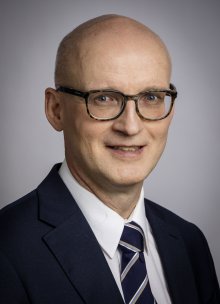
Eyjólfur Ármannsson
Infrastructure Minister, Flokkur fólksins
Born 1969-07-23
Próf frá East Aurora High School í New York-ríki 1988. Stúdentspróf MS 1989. Embættispróf í lögfræði HÍ 1998. Nám í Evrópurétti við Kaþólska háskólann í Leuven í Belgíu 1998. Hdl. 1999. Próf í verðbréfamiðlun 2000. LLM-próf í lögfræði frá Pennsylvaníuháskóla í Fíladelfíu í Bandaríkjunum.
|
110 speeches this session |
31,354 words total |
285 words avg per speech |
Eyjólfur Ármannsson's CV reads like the itinerary of a man who spent two decades searching for the right institution to run — and who, at 56, may finally have found it. Born in the Westman Islands in 1969, the son of a school principal and a nurse's aide, he attended East Aurora High School in New York State before returning to Iceland for a law degree from the University of Iceland, a European law certificate from the Catholic University of Leuven, and an LLM from the University of Pennsylvania. What followed was a twenty-year odyssey through Iceland's legal and financial machinery: district court attorney, Finance Ministry staffer, head of service at the Planning Agency, financial supervisor at the FME, assistant prosecutor in the National Commissioner's economic crimes unit during the banking crisis years, and then — as if Iceland were not enough — stints as a banking lawyer at DNB and Nordea in Oslo. He founded a law firm (VestNord Legal), worked at Isavia, went freelance, and then won a seat for Flokkur fólksins (People's Party) in Norðvesturkjördæmi in 2021. By December 2024 he was Minister of Transport and Municipal Affairs. By 2025, the ministry had been renamed and the portfolio expanded: he is now the Minister of Infrastructure and Local Government.
That career — lawyer, prosecutor, banker, regulator, and now cabinet minister — is the skeleton key to his parliamentary operation. He runs the infrastructure portfolio the way a site manager runs a construction project: on schedule, on budget, and with very little patience for people who want to re-pour the foundations after the concrete has set.
Thematic Profile
Of his 110 speeches and 31,354 words this session, the overwhelming centre of gravity is the samgönguáætlun (Transport Plan) for 2026--2040, a 15-year blueprint for roads, tunnels, harbours, and telecoms that he presented on 19 January in a speech exceeding 1,800 words — the longest presenting speech of the week and the culmination of a consultation process he traces back to 2021. Thirty-seven of his speeches that week alone were devoted to this single piece of legislation, an extraordinary dominance of floor time that turned Monday and Tuesday into a one-man infrastructure seminar.
The plan's headline numbers are designed to end arguments rather than start them. Over 1,000 billion ISK across 15 years. Road maintenance rising from 12--13 billion to 20 billion annually — enough, according to the Roads Administration, to stop the accumulation of infrastructure debt. A reordered tunnel priority list: Fljótagöng first, Fjarðagöng second, Súðavíkurgöng third. An infrastructure company — the innviðafélag — financed through equity contributions, loans, toll revenue, and pension fund investment. And the abolition of single-lane bridges on the ring road by 2040. When Eyjólfur says "fullfjármögnuð samgönguáætlun" (fully funded transport plan), he means it as a full stop, not an invitation to negotiate.
But the transport plan is only the most visible beam in a broader load-bearing structure. His portfolio spans borgarstefna (urban policy) for 2025--2040, where he laid out Iceland's first formal two-pole city strategy designating Reykjavík and Akureyri as the country's primary urban centres — 90% of the population lives on these two corridors. He mounted a systematic reform of taxi regulation, methodically cataloguing the failures of the 2023 deregulation: violence, harassment, tourist fraud, exam cheating, and what he called a "ófremdarástand" (state of dysfunction) in the industry. He introduced ship crew legislation to solve Landsbjörg's volunteer manning crisis for new rescue vessels. He presented the Infrastructure Ministry's 116 billion ISK budget allocation for 2026, with its 12.5% year-on-year increase. And in September's Prime Minister's policy debate, he delivered a compact, punchy speech quoting John F. Kennedy on American roads — the only time this session he has reached for a historical reference, and even then it was in the service of a spreadsheet.
The thematic through-line is not ideology but logistics. Eyjólfur does not speechify about the soul of the nation; he talks about tunnel boring sequences, fiscal framework alignment, and which regional consultation meeting happened where. The lawyer who once prosecuted economic crimes now prosecutes policy gaps with the same evidentiary precision.
Rhetorical DNA
His presenting speeches follow an architectural blueprint so consistent it amounts to a signature: context, problem, action, fiscal framework, details, referral to committee. No warm-up, no anecdotes, no poetic flourishes. By the second paragraph of the transport plan speech he is already explaining why no samgönguáætlun has been passed since 2020. The hallmark is the controlled deployment of specific numbers. Where other ministers gesture toward "significant investment," Eyjólfur names the figure, names the comparison, and names the year: "Úr 12--13 milljörðum upp í 20 milljarða" — from 12--13 billion to 20 billion. The numbers are not decoration. They are the argument itself.
When challenged, he shifts from technocrat to pugilist with surprising speed. His exchange style during the transport plan debate revealed a man who views parliamentary questions not as opportunities for dialogue but as objections to be overruled. "Hversu oft eigum við að setja sama hlutinn í samráð?" (How many times should we put the same thing out for consultation?) is delivered not as a question but as a door slammed shut. And when opponents claim his plan cannot be processed in one parliamentary term: "Það er bara ekki rétt, það er ekki sannleikanum samkvæmt" (That is simply not correct, it is not in accordance with the truth) — no hedging, no diplomatic softening, no acknowledgement that the other side might have a point. His 100% party loyalty score across 646 votes tells its own story: a coalition soldier who reserves his combativeness for the substance of his own portfolio.
Favourite Catchphrases
| Phrase (Icelandic) | Translation | Usage |
|---|---|---|
| "Fullfjármögnuð samgönguáætlun" | "Fully funded transport plan" | 12 times this week. His central selling point, deployed so often the opposition now quotes it back in air-quotes. |
| "Úr 12--13 milljörðum upp í 20 milljarða" | "From 12--13 billion up to 20 billion" | 5 times this week. The maintenance budget increase, recited like a catechism whenever road upkeep is questioned. |
| "Óskalistar síðustu ríkisstjórnar" | "Wish lists of the previous government" | 4 times this week. His dismissal of the 2023 transport plan — previous plans were dreams, his has a spreadsheet. |
| "Hversu oft eigum við að setja sama hlutinn í samráð?" | "How many times should we put the same thing out for consultation?" | 3 times this week. A rhetorical question deployed as a closed door. |
| "Við erum að fara í" | "We are going to" | Used throughout this session. His favourite verb construction — always forward motion, always in the present continuous. |
| "Klassískt dæmi" | "A classic example" | Used across multiple debates this session. His go-to preface when cataloguing policy failures, especially the taxi deregulation. |
Emotional Register
Eyjólfur operates in a narrower emotional band than most of his cabinet colleagues, but within that band he is remarkably consistent. Three registers dominate.
Technocratic authority is the default. The budget speech, the transport plan presentation, the ship crew legislation, the urban policy proposal — all delivered in the same measured, data-saturated tone. There is an almost deliberate suppression of passion, as if emotion would undermine the precision of the numbers. When presenting the 15-year transport plan, he listed 5,000 kilometres of roads, 38 harbours, 13 airports, and ferry routes with the affect of a man reading an inventory. He trusts his briefing papers more than his instincts, and he considers that a strength.
Controlled irritation emerges when the consultation process is questioned — his sore spot. Having conducted íbúafundir (citizen meetings) across all regions, having published both a green book and a white book, he treats scepticism about the adequacy of public engagement as a personal affront. The "hversu oft eigum við" retort carries a genuine edge — not parliamentary theatre but a man who feels his work is being disrespected. During the transport plan debate, when Njáll Trausti Friðbertsson pressed him on the missing infrastructure company legislation, Eyjólfur's response was not to concede the gap but to redirect: "Ég skora á hana að hlusta á þetta og styðja við bakið á þessari áætlun" (I challenge her to listen and support this plan). The cross-examiner does not like being cross-examined.
Prosecutorial conviction — rare but unmistakable — surfaces in the taxi reform speeches. The catalogue of abuses under the deregulated regime is delivered with a fervour absent from his infrastructure work: violence, harassment, fraud, exam cheating, regulatory capture. Here, Flokkur fólksins's populist DNA breaks through the technocratic veneer. "Þetta er klassískt dæmi um lög sem hafa leitt til verra ástands" (This is a classic example of laws that have led to worse conditions) — the former economic crimes prosecutor is back, and this time the defendants are bad regulations. He even takes a swipe at ESA — "ég hef sagt það við ESA líka að þeir eigi ekki að vera í pólitík á Íslandi" — with the confidence of a man who has litigated across jurisdictions and does not consider Brussels an upgrade.
What is notably absent is any register of doubt, reflection, or rhetorical vulnerability. Eyjólfur does not publicly wrestle with trade-offs. Tunnels are prioritised, budgets are allocated, consultations are completed. The machine runs.
The Verdict
The most productive minister on the floor of the 157th Althingi — 110 speeches, 31,354 words, and a week in January where he personally delivered 37 speeches and accounted for over 10,000 words of parliamentary record. Not the most eloquent minister in the cabinet, not the most charismatic, and certainly not the most quotable. What he is, unmistakably, is competent — and in a parliament that has not passed a transport plan since 2020, competence is the rarest commodity on offer.
The transport plan is the centrepiece of that competence, and it is also the test case. A trillion ISK over 15 years, a reordered tunnel programme, the infrastructure company model — it is the most ambitious piece of infrastructure legislation in a generation, and Eyjólfur has staked his ministerial reputation on getting it through parliament by spring. The opposition's objections are not frivolous: the enabling legislation for the infrastructure company has not been introduced, the "fully funded" label depends on budget assumptions that the fine print itself qualifies, and 37 speeches in a week can look less like mastery and more like an inability to delegate.
But the weakness is also the strength. Eyjólfur Ármannsson is the minister who has actually read every page of his own plan, who knows the difference between period one and period three funding, who can cite the maintenance debt figure and the OECD ranking and the single-lane bridge count from memory. He has struck a clear bargain with his coalition partners: give me the infrastructure portfolio, and I will deliver results that voters can drive on. The question is whether parliament will give him the tools to keep that promise — starting with the infrastructure company bill that, as of this week, remains a plan for a plan. He is the anti-visionary minister — not because he lacks vision, but because he has buried it so deep inside spreadsheets that it takes 37 speeches to excavate.
Key Legislation & Votes
Legislation Advancing
Legislation Advancing
| Issue | Title | Stage | Vote |
|---|---|---|---|
| #328 | sjúkratryggingar og ófrjósemisaðgerðir | Awaiting 2nd reading | Bill advances |
| #320 | opinber stuðningur við vísindi og nýsköpun | Awaiting 2nd reading | Bill advances |
| #319 | réttindi sjúklinga | Awaiting 2nd reading | Bill advances |
| #315 | landhelgi, aðlægt belti, efnahagslögsaga og landgrunn | Awaiting 2nd reading | Bill advances |
| #301 | lækningatæki | Awaiting 2nd reading | Bill advances |
| #322 | samgönguáætlun fyrir árin 2026--2040 ásamt fimm ára aðgerðaáætlun fyrir árin 2026--2030 | Awaiting 2nd reading | Resolution advances |
Stage key: 1st reading • In committee • 2nd reading • 3rd reading • Enacted
Get Þingfréttir by email
Weekly parliamentary digest — straight to your inbox every Sunday.
Subscribe