L157 #1: The Justice Minister's Flood
Editorial: The Week in Parliament
One minister delivered 20 of the week's 122 speeches and spoke nearly a third of all words uttered on the floor. Þorbjörg Sigríður Gunnlaugsdóttir, Justice Minister from Viðreisn (Reform Party), turned the Althingi chamber into a one-woman legislative seminar, presenting bills on restraining orders, immigration, the criminal code, gender equality, and public universities across a single two-day sitting. The rest of parliament mostly watched. Viðreisn alone produced 43 speeches -- nearly matching the combined output of all three opposition parties.
This was Session 157's opening week, and the new coalition chose breadth over caution. Nine bills advanced to second reading on January 14--15, all passing through procedural votes without recorded divisions -- a sign of either early consensus or an opposition still calibrating its lines of attack. The legislative menu reads like a reformist manifesto compressed into 48 hours: electronic ankle monitors for domestic violence perpetrators, consolidation of work and residence permits under a single agency, security detention for dangerous offenders, abolition of equal pay certification in its current form, agricultural commodity reform, foreign investment screening, and two public university bills. Each arrived wrapped in the same rhetorical packaging -- "einföldun" (simplification) and Nordic benchmarking -- but the substance ranged from the genuinely progressive to the politically expedient.
The most consequential bill was arguably number 298, on nálgunarbann og brottvísun af heimili (restraining orders and removal from the home). Iceland currently lacks legal authority to impose electronic monitoring on perpetrators who violate restraining orders. The Justice Minister cited statistics showing domestic violence reports rose 7% in the first nine months of 2025, with serious assaults up 33% -- 105 cases versus 79 the previous year. The gap between 95 restraining order requests and nearly 1,200 domestic violence reports tells its own story about victims' faith in existing protections. The bill borrows from Norwegian and Danish law, and for once the Nordic comparison feels earned rather than decorative.
The opposition's sharpest blow landed not on domestic policy but on national security. When Economy Minister Hanna Katrín Friðriksson presented bill 300 on screening foreign investments, former Prime Minister Sigurður Ingi Jóhannsson from Framsóknarflokkurinn (Progressive Party) dismantled the government's urgency narrative in three sentences: you sat on this for a year, transferred it between ministries, and now want parliament to rush. It was the kind of question that lands because it is unanswerable. Halla Hrund Logadóttir, also from the Progressives, pushed the debate toward sovereignty, arguing that selling farmland means selling natural resources -- geothermal energy, water, minerals -- a framing that resonates differently in a country without a standing army. The umhverfis- og samgöngunefnd (Environment and Transport Committee) led committee activity with three meetings and five public submissions, confirming that infrastructure and environmental policy will be an early battleground.
A government that presents four justice bills in a single afternoon is making a statement about pace, not just policy. But velocity is not the same as momentum. The real test comes in committee, where Sjálfstæðisflokkurinn (Independence Party) and the Progressives will have time to dissect the Nordic comparisons and ask whether einföldun means genuine reform or simply less oversight. Nine bills advancing without a single contested vote is not consensus -- it is the silence before the argument begins.
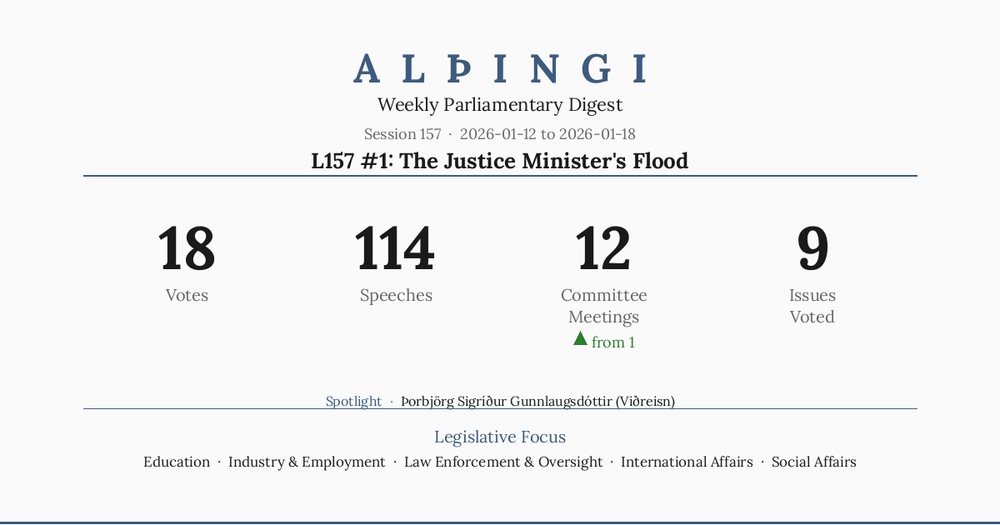
Week at a Glance
|
18
Votes |
122
Speeches |
12
▲ from 1
Committee Meetings |
9
Issues Voted |
Legislative focus: Education (4), Industry & Employment (4), Law Enforcement & Oversight (4), International Affairs (4), Social Affairs (3)
Parliamentary Awards
Session 157 • Recognising the quirks and patterns of Althingi
The Awards Column
The most revealing fact about this week's awards is not who won them but who won all of them. Justice Minister Þorbjörg Sigríður Gunnlaugsdóttir takes both the Mic Drop and the Broken Record crown -- the parliamentary equivalent of being named both best player and most predictable. When one minister accounts for a fifth of all speeches and a third of all words, the line between dominance and repetition is measured in paragraphs.
The opposition, meanwhile, contributed its finest moment not through rhetoric but through timing. Former Prime Minister Sigurður Ingi Jóhannsson needed only 323 words and one devastating question to expose the gap between the government's stated urgency and its actual calendar. In a week where Viðreisn ministers spoke at length about the need for speed, the Progressives proved that brevity can be its own kind of power.
Mic Drop of the Week
The single best speech of the week — as judged by our parliamentary critic.
Þorbjörg Sigríður's speech on bill 298, nálgunarbann og brottvísun af heimili (restraining orders and removal from the home), earned the week's top honour for combining legal precision with moral clarity. The 2,302-word address laid out the case for electronic ankle monitoring of domestic violence perpetrators -- a tool available across Scandinavia but absent from Icelandic law. She cited the gap between 1,200 domestic violence reports and just 95 restraining order requests as evidence of systemic failure, then delivered the speech's defining line: "Ég held að þetta sé grundvallarleikbreytir. Með því að gerandi beri ökklaband þá er hann meðvitaður um að með honum er fylgst" (I believe this is a fundamental game-changer. When the perpetrator wears an ankle monitor, he is aware that he is being watched). The sentence inverts the logic of protection -- shifting surveillance from victim to offender -- and does so with a simplicity that makes the policy feel inevitable. For a minister whose default mode is legislative genealogy and Nordic comparison, the directness was striking.
“Ég held að þetta sé grundvallarleikbreytir. Með því að gerandi beri ökklaband þá er hann meðvitaður um að með honum er fylgst.”
I believe this is a fundamental game-changer. When the perpetrator wears an ankle monitor, he is aware that he is being watched.
Þorbjörg Sigríður Gunnlaugsdóttir (V), Justice Minister — 2302 words on nálgunarbann og brottvísun af heimili (2026-01-15).
The Justice Minister presented electronic ankle monitoring for domestic violence perpetrators — a piece of legislation that shifts the burden of fear from victim to offender. The speech combined legal precision with visible conviction, citing rising assault statistics and repeated restraining order violations to make a case that was as much moral argument as policy proposal.
Sharpest Question
The most incisive question or challenge posed in debate this week.
Sigurður Ingi Jóhannsson from Framsóknarflokkurinn (Progressive Party) needed precisely three sentences to dismantle Economy Minister Hanna Katrín Friðriksson's plea for fast-tracking the foreign investment screening bill. "Hvað kom í veg fyrir það að ríkisstjórnin hreinlega flýtti sér að leggja fram slíkt mál?" (What prevented the government from simply hurrying to present such a bill?) -- asked with the quiet authority of a former Prime Minister who had been calling for this legislation for nearly a year. He noted that the bill had been transferred between ministries, delayed through bureaucratic reshuffling, and was now being presented with manufactured urgency. The question was unanswerable not because it was clever but because it was true, and the minister's response -- a pivot to the bill's technical merits -- confirmed that the timeline problem had no defence.
“Hvað kom í veg fyrir það að ríkisstjórnin hreinlega flýtti sér að leggja fram slíkt mál?”
What prevented the government from simply hurrying to present such a bill?
Sigurður Ingi Jóhannsson (Fr) — on rýni á fjárfestingum erlendra aðila vegna þjóðaröryggis og allsherjarreglu (2026-01-14).
The former Prime Minister had been calling for this foreign investment screening bill for nearly a year. When it finally arrived with a plea for fast-tracking, he dismantled the urgency argument in three sentences: you sat on it for a year, you transferred it between ministries, and now you want parliament to rush?
Broken Record Award
MPs who repeat themselves most — same catchphrases, recycled arguments, and recurring anecdotes across different speeches.
Five MPs earned Broken Record citations this week, but the pattern tells a single story: when the government's legislative agenda is this concentrated, repetition is not a flaw -- it is strategy.
Þorbjörg Sigríður leads with a score of 0.88 out of 1.0, deploying "einföldun" (simplification) eight times across immigration, equal pay, domestic violence, and criminal code bills as if it were a universal solvent for Iceland's regulatory problems. Four bills in one week means four variations on the same thesis -- that Iceland is behind the Nordics and simplification is the cure -- delivered with the discipline of a minister who knows the committee chairs are listening.
Hanna Katrín Friðriksson scored 0.75, turning "þjóðaröryggi og allsherjarreglu" (national security and public order) into a refrain so persistent it could have been the bill's subtitle. When your two bills both concern national security and Nordic alignment, every answer becomes a variation on the same reassurance -- we checked with the Danes and we are not going too far.
Diljá Mist Einarsdóttir from Sjálfstæðisflokkurinn (Independence Party) scored 0.70 with six speeches and one obsession: jafnlaunavottun (equal pay certification), referenced in every speech regardless of topic. She owns the equal pay portfolio in her party caucus the way a dog owns a bone -- she has been gnawing it so long the substance is gone but the grip remains.
Finance Minister Daði Már Kristófersson scored 0.65, treating hostile questions as teaching moments and citing the same 100-billion-krona infrastructure budget figure with the patience of a professor who suspects the student has not done the reading.
Halla Hrund Logadóttir from the Progressives rounds out the list at 0.62, the sovereignty sentinel who sees every policy debate through the lens of Icelandic resource ownership. Her argument that selling farmland means selling geothermal and water resources has the reliability of a geyser -- you always know when it is coming, and it always reaches the same height.
| Name | Speeches | Top Catchphrase | Uses |
|---|---|---|---|
| Þorbjörg Sigríður Gunnlaugsdóttir (V) | 20 | “einföldun” | 8× |
| Hanna Katrín Friðriksson (V) | 16 | “þjóðaröryggi og allsherjarreglu” | 7× |
| Diljá Mist Einarsdóttir (Sj) | 6 | “gleðidagur á Alþingi” | 2× |
| Daði Már Kristófersson (V) | 7 | “100 milljarða króna” | 3× |
| Halla Hrund Logadóttir (Fr) | 5 | “þegar við seljum jarðir þá erum við að selja auðl…” | 2× |
1. Þorbjörg Sigríður Gunnlaugsdóttir, Justice Minister (Viðreisn)
Four bills in one week means four variations on the same thesis — that Iceland is behind the Nordics and simplification is the cure — delivered with the discipline of a minister who knows the committee chairs are listening.
- “einföldun” (8×) — Used across immigration, equal pay, domestic violence, and criminal code bills as the universal rationale for reform.
- “Norðurlöndin” (6×) — Nordic comparison deployed in every bill presentation — Iceland trails the other Nordics in administrative efficiency, electronic monitoring, and work permit processing.
- “tímabærar úrbætur” (4×) — Each bill framed as overdue reform that previous governments discussed but never delivered.
2. Hanna Katrín Friðriksson, Economy and Industry Minister (Viðreisn)
When your two bills both concern national security and Nordic alignment, every answer becomes a variation on the same reassurance — we checked with the Danes and we are not going too far.
- “þjóðaröryggi og allsherjarreglu” (7×) — The bill title itself became a refrain, invoked in nearly every response to opposition questions on foreign investment screening.
- “sambærileg löggjöf á Norðurlöndum” (5×) — Nordic precedent cited across both bills to deflect concerns about overreach — whether screening foreign investors or reforming agricultural subsidies.
3. Diljá Mist Einarsdóttir (Sjálfstæðisflokkur)
Diljá Mist owns the equal pay portfolio in the Independence Party caucus the way a dog owns a bone — she has been gnawing it so long the substance is gone but the grip remains.
- “gleðidagur á Alþingi” (2×) — Ironic celebration framing when the government finally delivered the equal pay reform she had demanded — deployed twice with diminishing impact.
- “jafnlaunavottun” (5×) — Equal pay certification referenced in every speech regardless of topic, including during general debate on Iran and international affairs.
Data sourced from Althingi Open Data (althingi.is). Generated 2026-01-18.
MP Spotlight
A deep dive into one parliamentarian each week

Þorbjörg Sigríður Gunnlaugsdóttir
Justice Minister, Viðreisn
Born 1978-05-23
Stúdentspróf MR 1998. Cand. juris HÍ 2005. LL.M.-gráða (Master of Laws) frá Columbia University í Bandaríkjunum 2011.
|
105 speeches this session |
45,223 words total |
430 words avg per speech |
Þorbjörg Sigríður Gunnlaugsdóttir arrived at the Justice Ministry in December 2024 with the CV of someone who had been circling the criminal justice system from every possible angle: journalist at DV during her university years, prosecutor on the violence crimes unit, judicial assistant in the Reykjavik District Court, law faculty dean at Bifrost, and back to the State Prosecutor's office. Born in 1978, educated at the University of Iceland and Columbia Law School, she brought to the ministry something rare in Icelandic politics -- a career spent almost entirely inside the machinery she now controls. Her mother, Guðrún Helga Brynleifsdóttir, is a Supreme Court attorney; her former husband, Ágúst Ólafur Ágústsson, is a sitting MP. The law is not her profession. It is her family business.
Thematic Profile
Her legislative portfolio this session reads like a comprehensive audit of Iceland's institutional gaps. At its centre sits immigration and border enforcement -- the brottfararstöð (departure terminal) bill, the revocation of international protection, the consolidation of work and residence permits under the Immigration Directorate, and the tightening of student visa rules. Together these bills consume over 14,000 words of floor time and constitute the most ambitious rewrite of Iceland's immigration framework in a generation. Her framing is relentlessly comparative: Iceland is "the only Schengen state" without a departure facility; its 18-month automatic residency rule exists "in no other Nordic country"; its student visa regime has produced "55% more permits than other Nordic countries" since 2020. The Nordic benchmark is not decoration -- it is the load-bearing wall of every argument she constructs.
The second pillar is victim protection and criminal law reform. The restraining order bill introducing electronic ankle monitoring, the security measures overhaul for dangerous offenders (öryggisráðstafanir), and the proceeds-of-crime recovery framework form a triptych of enforcement modernisation. The ankle bracelet proposal is perhaps her most personal legislation. She opens the speech declaring "ég er mjög stolt af þessu frumvarpi" (I am very proud of this bill) and proceeds to narrate, with prosecutorial specificity, the statistics of domestic violence -- 900 reports in nine months, a 7% increase, 32% of victims being children -- before pivoting to the inadequacy of existing restraining orders. This is the former violence crimes prosecutor speaking directly through the minister, marshalling evidence the way she once built indictments.
The third stream is gender equality and institutional rationalisation. The equal pay certification bill performs the delicate act of dismantling jafnlaunavottun (equal pay certification) while insisting the underlying obligation remains sacred. She frames it as responsiveness -- "Við höfum hlustað og meðtekið gagnrýni atvinnulífsins" (we have listened and accepted the criticism of the business community) -- while raising the employee threshold from 25 to 50 and replacing external audits with self-reported data. The sheriff system consolidation (sýslumaður), reducing nine offices to one while preserving all 27 service locations, and the digital court proceedings bill round out a portfolio that is, in aggregate, a sustained argument for fewer offices, fewer agencies, fewer uniquely Icelandic rules, and more Nordic conformity.
Two reports introduced this week -- on regional development strategy and the economic impact of the EU Emissions Trading System on Iceland -- suggest her legislative reach extends beyond justice into the territory of economic reform, though these are government reports rather than her own bills. In all, she has touched more policy domains in her first three months than most ministers cover in a full term.
The breadth is intentional. Her gender equality action plan speech reveals the strategic logic: 40 actions across four years, each tied to UN Sustainable Development Goals, each assigned to specific ministries. She added a 41st action -- a men's equality committee -- after listening to parliamentary debate, a move she presents as evidence of responsiveness but which also demonstrates her willingness to expand scope mid-stream. The kirkjugarðar (cemeteries) bill, seemingly anomalous in a justice portfolio, shows the same instinct: a small practical problem -- mortuary funding shortfalls caused by population growth and longer intervals between death and burial -- solved by enabling fee collection. Even in the minor bills, the method is consistent: identify the gap, cite the data, propose the Nordic-compatible fix.
Rhetorical DNA
Gunnlaugsdóttir's speeches owe more to legal briefs than to political oratory. Nearly every major address opens by establishing the legislative genealogy of the bill -- who tried this before, when it failed, and why she is back. The security measures bill traces the lineage to a 2012 proposal by former Interior Minister Ögmundur Jónasson, through a 2015 policy paper and a 2022 consultation draft. She never presents a proposal as novel; everything is the long-overdue completion of work others began. From there, arguments are built as labelled blocks -- "fyrsti punkturinn," "annar punkturinn" -- each with its own internal logic. This is a mind that thinks in outlines, not in streams.
Where other ministers deploy passion, Gunnlaugsdóttir deploys context. Her favourite device is the comparative statistic delivered with understated alarm: 10,632 asylum applications in three years against a population of 380,000, then a conclusion presented as so obvious it barely needs stating. She pre-empts criticism by articulating it herself -- "Einhver gæti spurt sem svo" (someone might ask) -- before dismantling the objection. In the departure terminal debate, she freely admits the policy is "íþyngjandi" (burdensome) before arguing it is less so than the status quo of housing asylum seekers in prison cells. This prosecutorial concession-then-rebuttal rhythm gives her speeches a quality of apparent fairness, even when the conclusion was never in doubt.
Favourite Catchphrases
| Phrase (Icelandic) | Translation | Usage |
|---|---|---|
| "í mínum huga" | "in my mind" | Marks personal opinion within a sea of statute and statistic. 32 occurrences (this session). |
| "einföldun" | "simplification" | The universal rationale -- applied to immigration, equal pay, criminal code, and court proceedings alike. 8 uses (this week). |
| "séríslenskar reglur" | "uniquely Icelandic rules" | Always pejorative. If a rule is uniquely Icelandic, it is by definition a problem to be cured (this session). |
| "eins og ég segi" | "as I say" | Self-referential connective tissue -- the verbal equivalent of "see above." Dozens of uses (this session). |
| "hér á landi" | "here in this country" | Grounds abstract policy in Icelandic reality, usually seconds before a Nordic comparison. 31 uses (this session). |
| "tímabærar úrbætur" | "overdue improvements" | Each bill framed as reform that previous governments discussed but never delivered. 4 uses (this week). |
| "Norðurlöndin" | "the Nordic countries" | The comparative anchor of her entire programme. 6 explicit invocations (this week). |
| "lokaúrræði" | "last resort" | Every coercive measure -- departure terminal, ankle monitors, security detention -- framed as the final option (this session). |
Emotional Register
The Methodical Prosecutor. This is her default setting and the register in which she is most comfortable. The voice is cool, sequential, evidence-laden. Statistics are deployed like exhibits in court -- "779 gerendur samanborið við 715 árið á undan, sem er um 9% aukning" (779 perpetrators compared to 715 the year before, a 9% increase) -- and conclusions are drawn as if they are self-evident. She rarely raises her voice in this mode; the architecture of the argument is meant to be its own persuasion. It dominates the immigration speeches, the criminal procedure debates, the sheriff consolidation bill, and the proceeds-of-crime framework. When she says "ég ætla bara að segja það berum orðum" (I'm just going to say it in plain words), what follows is invariably a number.
The Controlled Moralist. When she enters the domains of domestic violence and gender equality, a carefully calibrated indignation surfaces. "Það er ekki mannréttindi að fá óáreitt að ofsækja fólk eða áreita" (it is not a human right to harass people with impunity), she declares in the restraining order speech, and for a moment the legal architecture drops away to reveal conviction. In the gender equality action plan debate, she pauses mid-speech to ad-lib: "Markmiðið er auðvitað líka að verja jafnrétti" (the goal is of course also to defend equality) -- the emphasis on "verja" suggesting she believes the gains are genuinely under threat. She lists the consequences of domestic violence with clinical precision -- depression, suicidal ideation, social isolation, children's academic failure -- but the very thoroughness of the catalogue carries emotional weight. The moralism is real but never uncontrolled; it functions as evidence of seriousness rather than as a departure from her analytical frame.
The Sardonic Pragmatist. Rarer but distinctive. It surfaces late in evening sessions when fatigue makes candour easier. Introducing the digital court proceedings bill, she notes its full official title -- "frumvarp til laga um breytingu á ýmsum lögum" (bill to amend various acts) -- and quips "það væri gott að stoppa hér" (it would be nice to stop there), drawing a laugh. In the departure terminal debate, she loses track of her Nordic enumeration -- "Nú er ég búin að gleyma hinum Norðurlöndunum, Danmörk Færeyjar, Álandseyjar... já, allihopa" (now I've forgotten the other Nordic countries, Denmark, Faroe Islands, Aland... yes, all of them). These moments of self-aware levity reveal a speaker who trusts the chamber enough to briefly lower the brief. The contrast with her default precision makes the humour land harder.
The Verdict
Þorbjörg Sigríður is the most productive minister in Session 157 by any quantitative measure -- 105 speeches, 45,223 words, 100% party loyalty across 538 active votes, zero dissents. She is not following the Viðreisn party line; the Viðreisn party line runs through her. Her programme of institutional modernisation, Nordic alignment, and bureaucratic consolidation is so precisely her own intellectual territory that dissent would require disagreeing with herself.
The strength is also the limitation. Her relentless comparativism can make Iceland's policy choices feel predetermined by geography rather than debated on their merits. "Séríslenskar reglur" is always a negative, never a feature worth preserving. When she dismantles equal pay certification while proclaiming the underlying duty sacred, one wonders whether the duty without the mechanism is a principle or a press release. And her habit of framing deregulation as "listening" can sound less like democratic responsiveness and more like rhetorical misdirection -- particularly when the listening produced exactly the outcome the business community requested.
But as a parliamentary performer, she is formidable. The courtroom training shows in every speech: the careful establishment of jurisdiction, the pre-emptive concessions, the labelled exhibits, the summation that sounds like an inevitable conclusion rather than a political choice. She does not delegate her arguments. She does not simplify for the chamber. She treats parliament as a court that needs to be persuaded with evidence, and she prepares her case with the diligence of someone who has spent a career knowing that sloppy briefs lose cases. In a coalition where pace matters more than consensus, the Justice Ministry has exactly the operator it needs. The question is whether the operator's certainty leaves enough room for the doubts that good legislation requires.
Her political brand is unusual in the Icelandic context: a minister who is neither ideologue nor technocrat but something closer to an institutional engineer. She does not promise transformation -- she promises that things will work the way they work in Copenhagen and Oslo. For a country that has spent decades accumulating séríslenskar reglur, that is either the most radical programme in government or the most conservative. Þorbjörg Sigríður would say it is simply overdue. The opposition, when it finds its voice, will need to decide whether the Nordic standard she invokes so fluently is a destination or a straitjacket.
Key Legislation & Votes
Legislation Advancing
Legislation Advancing
| Issue | Title | Stage | Vote |
|---|---|---|---|
| #316 | útlendingar og atvinnuréttindi útlendinga | Awaiting 2nd reading | Bill advances |
| #317 | opinberir háskólar | Awaiting 2nd reading | Bill advances |
| #313 | almenn hegningarlög | Awaiting 2nd reading | Bill advances |
| #309 | opinberir háskólar | Awaiting 2nd reading | Bill advances |
| #298 | nálgunarbann og brottvísun af heimili | Awaiting 2nd reading | Bill advances |
| #297 | jöfn staða og jafn réttur kynjanna | Awaiting 2nd reading | Bill advances |
| #300 | rýni á fjárfestingum erlendra aðila vegna þjóðaröryggis og allsherjarreglu | Awaiting 2nd reading | Bill advances |
| #296 | stuðningur við nýsköpunarfyrirtæki | Awaiting 2nd reading | Bill advances |
Stage key: 1st reading • In committee • 2nd reading • 3rd reading • Enacted
Get Þingfréttir by email
Weekly parliamentary digest — straight to your inbox every Sunday.
Subscribe