Baksýnisspegill #1: The Icesave Filibuster
Editorial: The Week in Parliament
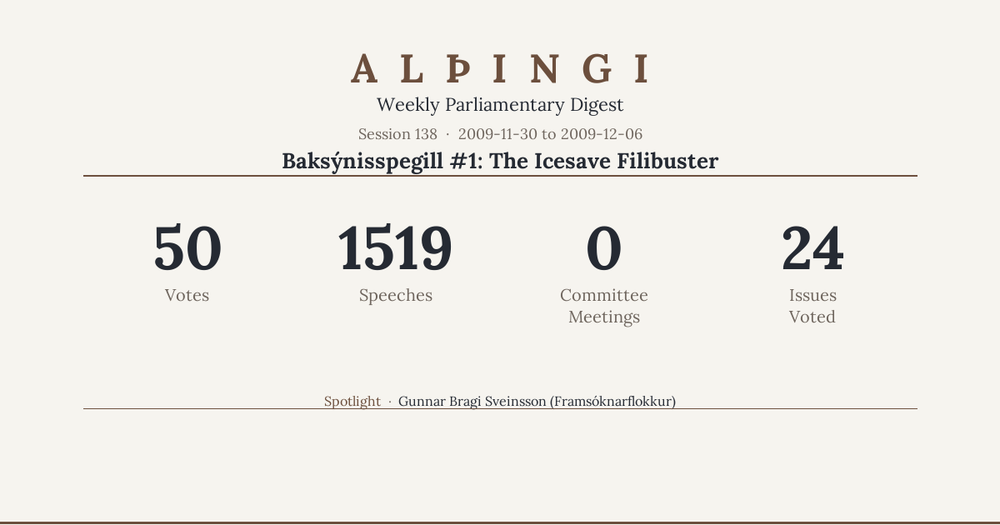
In one week, 63 members of parliament produced 1,519 speeches totalling 451,770 words. That is more than most sessions generate in a month. Zero new bills were introduced. Zero committee meetings took place. Fifty votes were held, twenty-four of them crammed into a single Saturday afternoon. The week of 30 November 2009 was the Icesave filibuster, and everything Althingi did -- and failed to do -- flowed from that one fact.
Bill 76, ríkisábyrgð á lántöku Tryggingarsjóðs innstæðueigenda og fjárfesta (state guarantee on borrowing by the Depositors' and Investors' Guarantee Fund), was the government's second attempt to settle the fallout from the October 2008 banking collapse. When Landsbanki fell, British and Dutch savers held hundreds of billions of kronur in its Icesave online accounts. London and The Hague compensated their depositors and demanded reimbursement from Reykjavik. The bill proposed an unconditional sovereign guarantee on the debt. The opposition -- Sjálfstæðisflokkurinn (Independence Party), Framsóknarflokkurinn (Progressive Party), and Hreyfingin (the Movement) -- considered the terms unconscionable and the constitutional basis doubtful, and they used the only weapon available to a minority in a parliamentary system: they talked.
Gunnar Bragi Sveinsson of Framsóknarflokkurinn led the charge with 109 speeches and 28,565 words. Höskuldur Þórhallsson followed with 87 speeches, Pétur H. Blöndal with 86, and Sigmundur Davíð Gunnlaugsson with 84. Of the week's 1,519 speeches, 1,285 concerned the Icesave bill alone. The three opposition parties coordinated a round-the-clock relay: Framsóknarflokkurinn provided the engine room, Sjálfstæðisflokkurinn supplied the legal firepower, and Hreyfingin -- with Þór Saari's 57 speeches -- added volume. The filibusterers were not simply burning time. Speech after speech returned to a substantive core: three of Iceland's most respected constitutional scholars -- Lárus L. Blöndal, Sigurður Lindal, and Stefán Már Stefánsson -- had published an analysis arguing that the bill's open-ended, unconditional guarantee violated Articles 1, 40, and 41 of the constitution. Gunnar Bragi read their conclusions into the record repeatedly, demanding that the Budget Committee obtain formal legal opinions before voting. Ásbjörn Óttarsson cited Eva Joly's international defence of Iceland's position. Vigdís Hauksdóttir dismantled the bill's sovereignty waiver clause by clause. The arguments varied -- legal, economic, moral -- but the conclusion was uniform: this deal must not pass in this form.
On the government side, the response was strategically asymmetric. Prime Minister Jóhanna Sigurðardóttir delivered precisely two speeches all week, refusing to give the filibuster a high-value target. Finance Minister Steingrímur J. Sigfússon shouldered the entire burden: 49 speeches and 21,807 words, including a landmark 5,166-word counter-attack on 2 December in which he catalogued, with stopwatch precision, how quickly the then-opposition had cooperated with emergency legislation during the autumn 2008 crisis. The coalition's party discipline held: Samfylkingin (Social Democratic Alliance) cast 160 yes-votes without a single defection; Vinstri grænir (Left-Green Movement) cast 135. The opposition, when it showed up to vote at all, voted no or abstained strategically.
Saturday 5 December revealed the week's hidden second act. Between 16:19 and 17:35, the government rushed 24 votes on twelve unrelated bills through the chamber -- auditors, insurance regulation, deposit guarantees, EEA services, environmental taxation -- while the opposition was largely absent or declining to vote. Normal legislative business had been reduced to a procedural sprint conducted while nobody was looking. Yet the machinery of parliament had not entirely seized: 123 submissions reached committees during the week, with the Environment Committee alone receiving 25. The institution functioned backstage even as the main stage was occupied by a single, consuming drama.
The filibuster did not end that week, and the bill did not die. It eventually passed Althingi, 33 to 30. But President Ólafur Ragnar Grímsson refused to sign it -- invoking Article 26 of the constitution for the first time to trigger a national referendum. The nation rejected the Icesave deal in March 2010. A renegotiated second deal was rejected again in April 2011. In January 2013, the EFTA Court acquitted Iceland: no legal obligation required the state to guarantee the deposits of a private bank's foreign branches. The 451,770 words spoken in the first week of December 2009 were not wasted breath. They were the opening argument in a case Iceland would win.
Week at a Glance
|
50
Votes |
1519
Speeches |
0
Committee Meetings |
24
Issues Voted |
Party Voting Patterns
Absence Rate
votes with tallies
Individual Votes
Most Words Spoken
Parliamentary Awards
Session 138 • Recognising the quirks and patterns of Althingi
The Awards Column
The Icesave filibuster consumed 1,285 of the week's 1,519 speeches, but the moments that mattered most were not the ones that filled the hours. They were a finance minister's counter-attack built on stopwatch data, a future prime minister's 216-word logical trap, a sitting prime minister's calculated silence, and three government figures who discovered that saying the same thing repeatedly does not make it more convincing. The filibuster was the weather; these were the lightning strikes.
Of all the ironies this week produced, the sharpest may be this: the most devastating speech in defence of the Icesave bill was not about Icesave at all. It was about what happens when an opposition remembers its own record -- and what it means when it forgets.
Mic Drop of the Week
The single best speech of the week — as judged by our parliamentary critic.
Steingrímur J. Sigfússon had sat quietly for ten days. The Finance Minister and leader of Vinstri grænir (Left-Green Movement) had watched the opposition fill the chamber with constitutional arguments, fiscal projections, and appeals to sovereignty. On 2 December, he rose and delivered 5,166 words that reframed the entire debate.
The weapon was a stopwatch. Steingrímur had compiled a meticulous timeline of every piece of emergency legislation passed during the autumn 2008 crisis, when he had been opposition leader and the current filibusterers had been in government. The Emergency Act after the bank collapse: two hours and four minutes. Currency controls: two hours. The Special Prosecutor's office: two hours and forty-nine minutes. Pension fund amendments: twenty-eight minutes. Alcohol and tobacco tax increases: five minutes. Oil levies: four minutes. Item after item, he catalogued how quickly the previous Althingi had acted under extreme pressure -- with the full cooperation of the then-opposition.
"Ég minnist þess ekki að ég hafi brugðið fæti fyrir stjórnvöld við þær aðstæður að orðið hafi efnahagshrun og það þyrfti að grípa til viðamikilla ráðstafana til að halda hlutum gangandi og afstýra mikilli þjóðarvá" ("I do not recall ever having tripped up the government under those circumstances when an economic collapse had occurred and sweeping measures were needed to keep things running and avert a great national calamity"). The sentence was the hinge. Everything before it was evidence; everything after was verdict. If the opposition could cooperate in hours during the 2008 crash, why could it not show the same restraint now? The question answered itself.
“Ég minnist þess ekki að ég hafi brugðið fæti fyrir stjórnvöld við þær aðstæður að orðið hafi efnahagshrun og það þyrfti að grípa til viðamikilla ráðstafana til að halda hlutum gangandi og afstýra mikilli þjóðarvá.”
I do not recall ever having tripped up the government under those circumstances when an economic collapse had occurred and sweeping measures were needed to keep things running and avert a great national calamity.
Steingrímur J. Sigfússon (Vg), Finance Minister — 5166 words on ríkisábyrgð á lántöku Tryggingarsjóðs innstæðueigenda og fjárfesta (2009-12-02).
The Finance Minister's defining counter-attack on the filibuster: a meticulous, time-stamped record of how his own opposition never obstructed emergency legislation during the 2008 crash, followed by a sweeping moral indictment of the current deadlock. At 5,166 words it is the most structurally ambitious speech of the week, reframing the Icesave standoff from a legal dispute into a question of democratic responsibility.
Sharpest Question
The most incisive question or challenge posed in debate this week.
Sigmundur Davíð Gunnlaugsson needed 216 words to expose a contradiction the government had maintained for weeks unchallenged.
The Prime Minister's position was that Iceland's obligations were to pay exactly what Britain and the Netherlands demanded. Her ministers simultaneously claimed they had fought to uphold Iceland's legal rights in the negotiations. Sigmundur Davíð placed these two assertions side by side and asked the obvious question: "Forsætisráðherra lítur sem sé svo á að skuldbindingar okkar séu þær að borga þetta nákvæmlega eins og Bretar og Hollendingar ætlast til. Hvernig kemur það heim og saman við fullyrðingar ráðherra þess efnis að þeir hafi reynt að halda á lagalegum rétti okkar?" ("The Prime Minister apparently takes the view that our obligations are to pay this exactly as Britain and Holland demand. How does that square with the ministers' claims that they tried to uphold our legal rights?")
The strength of the question is measurable in what followed: nothing. No minister could answer it convincingly because both propositions could not be simultaneously true. Either Iceland was paying what was demanded and the legal defence was theatre, or the ministers had genuinely fought and the Prime Minister was misrepresenting the outcome. Sigmundur Davíð did not need to choose. He let the contradiction do the work.
“Forsætisráðherra lítur sem sé svo á að skuldbindingar okkar séu þær að borga þetta nákvæmlega eins og Bretar og Hollendingar ætlast til. Hvernig kemur það heim og saman við fullyrðingar ráðherra þess efnis að þeir hafi reynt að halda á lagalegum rétti okkar?”
The Prime Minister apparently takes the view that our obligations are to pay this exactly as Britain and Holland demand. How does that square with the ministers' claims that they tried to uphold our legal rights?
Sigmundur Davíð Gunnlaugsson (Fr) — on ríkisábyrgð á lántöku Tryggingarsjóðs innstæðueigenda og fjárfesta (2009-12-03).
A precise logical trap that exposes the core contradiction in the government's position: the Prime Minister insists Iceland must pay exactly what Britain and Holland demand, yet her ministers simultaneously claim they defended Iceland's legal right not to pay. The clean, 216-word andsvar closes with a rhetorically devastating coda questioning whether anyone who speaks with such self-contradiction could have mounted a real legal defence for Iceland.
The Quiet One
The Phantom
Jóhanna Sigurðardóttir: 2 speeches. Her Finance Minister: 49 speeches, 21,807 words. The entire parliament: 1,519 speeches.
The Prime Minister of Iceland sat nearly silent through the most consequential parliamentary week of her tenure. This was not absence -- Jóhanna was present. It was strategy. In a filibuster designed to provoke, the smartest response was to deny the provocateurs their preferred target. Every time the opposition goaded the government, Steingrímur answered. Every procedural challenge, every constitutional question, every demand for ministerial presence -- the Finance Minister absorbed it all.
A prime minister stepping to the podium would have given the filibuster exactly what it needed: a new focal point, fresh material for andsvör (replies), and the symbolic escalation of the head of government engaging directly with what the opposition characterised as an unconstitutional act. Jóhanna refused to provide it. Three weeks later, Althingi passed the bill 33 to 30. The silence had served its purpose.
Broken Record Award
MPs who repeat themselves most — same catchphrases, recycled arguments, and recurring anecdotes across different speeches.
Gylfi Magnússon, the Commerce Minister, introduced eleven bills during the week, each opening with the identical formula: "Ég mæli fyrir frumvarpi til laga" ("I present a bill"). Repetition score: 0.72 out of 1. A minister dispatched to the chamber to process routine legislation while the political world burned around him, Gylfi delivered each introduction with the same procedural cadence whether the subject was insurance regulation or currency exchange. The clock strikes every hour regardless of whether anyone is listening.
Árni Páll Árnason, the Social Affairs Minister, leaned on "koma í veg fyrir" ("to prevent") across his interventions -- the defensive grammar of a minister explaining why the filibuster threatened the legislative agenda. Score: 0.65. The argument was sound the first time. By the fourth repetition, it had become a verbal tic that proved the opposition's point: the government had only one response to the obstruction, and it was not working.
Ólína Kjerúlf Þorvarðardóttir of Samfylkingin (Social Democratic Alliance) deployed "ekki áhyggjur af þessu" ("don't worry about this") as an all-purpose response to opposition concerns across seven speeches. Score: 0.61. When the nation was consumed with anxiety about an unprecedented sovereign guarantee, telling people not to worry was less a rhetorical strategy than a confession that no better answer was available.
| Name | Speeches | Top Catchphrase | Uses |
|---|---|---|---|
| Gylfi Magnússon (Utan flokka) | 11 | “ég mæli fyrir frumvarpi til laga” | 9× |
| Árni Páll Árnason (Sf) | 5 | “koma í veg fyrir að meiri hlutinn fái” | 4× |
| Ólína Kjerúlf Þorvarðardóttir (Sf) | 7 | “ekki áhyggjur af þessu” | 5× |
1. Gylfi Magnússon (Utan flokka)
The Minister of Business Affairs cycles through near-identical bill introductions — 'ég mæli fyrir frumvarpi til laga' followed by formulaic procedural language — across 11 speeches, as if reading from the same template each time.
- “ég mæli fyrir frumvarpi til laga” (9×) — Formulaic bill introduction used identically in nearly every speech.
2. Árni Páll Árnason, Social Affairs and Insurance Minister (Samfylkingin)
The Social Affairs Minister leans on the same defensive frame in each intervention: the opposition's filibuster is designed 'to prevent the majority from getting its way,' recycling this construction across 5 speeches as if stuck on a single talking point.
- “koma í veg fyrir að meiri hlutinn fái” (4×) — Defensive framing of the filibuster as anti-democratic obstruction.
3. Ólína Kjerúlf Þorvarðardóttir (Samfylkingin)
The coalition MP's go-to dismissal — 'ekki áhyggjur af þessu' (don't worry about this) — surfaces repeatedly across 7 speeches, a verbal tic that undercuts the gravity of the opposition's constitutional arguments.
- “ekki áhyggjur af þessu” (5×) — Dismissive refrain used to wave away opposition concerns.
Data sourced from Althingi Open Data (althingi.is). Generated 2009-12-06.
MP Spotlight
A deep dive into one parliamentarian each week

Gunnar Bragi Sveinsson
Framsóknarflokkur
Born 1968-06-09
Stúdentspróf FNV á Sauðárkróki 1989. Nám í atvinnulífsfélagsfræði við HÍ.
|
493 speeches this session |
168,491 words total |
341 words avg per speech |
Gunnar Bragi Sveinsson stood up 109 times in one week. One hundred and nine speeches, 28,565 words, six days of parliamentary siege warfare -- more than any other MP in the Icesave filibuster, more than most backbenchers produce in an entire session. The number alone is remarkable. What makes it instructive is that almost none of those speeches were memorable as oratory. Gunnar Bragi was not trying to be eloquent. He was trying to be inexhaustible, and in that ambition he succeeded completely. The Framsóknarflokkurinn (Progressive Party) MP for Norðvesturkjördæmi (Northwest constituency) turned endurance into a political method, and the method worked.
Thematic Profile
Two themes dominate Gunnar Bragi's parliamentary output across Session 138: constitutional sovereignty and fiscal survivability. They are distinct arguments, but he wielded them as a single blade.
The constitutional case was built almost entirely on external authority. In the early hours of 3 December, Gunnar Bragi made the article by Lárus L. Blöndal, Sigurður Lindal, and Stefán Már Stefánsson -- three of Iceland's most eminent constitutional scholars -- the cornerstone of his filibuster. He read their analysis into the record section by section, under self-imposed subheadings: "Óviss skuldbinding" (Uncertain obligation), "Réttur framtíðarinnar" (The right of the future), "Afleiðingarnar" (The consequences). The scholars' conclusion was that the bill's open-ended sovereign guarantee likely violated Articles 1, 40, and 41 of the constitution. Gunnar Bragi did not paraphrase; he quoted, and then demanded action: "Ég fullyrði, frú forseti, að þessir heiðursmenn setja ekki fram slíkar vangaveltur ef ekki er innstæða fyrir þeim" ("I assert, Madam Speaker, that these honourable men do not put forward such reflections unless there is substance behind them"). The demand was always the same -- that the Budget Committee obtain formal written opinions before any vote. It was never granted.
The fiscal argument was sharper and more original. In a reply on 3 December, Gunnar Bragi produced a calculation that became his signature data point: approximately 80,000 income-tax payers would need to service the Icesave payments through 2016, leaving only 100,000 to fund the rest of the state. "Mér vitanlega gengur það ekki upp að nota skatta sömu einstaklinga í að borga af Icesave-reikningunum og að standa undir velferðarkerfinu" ("As I see it, you cannot use the taxes of the same individuals to pay off the Icesave bills and sustain the welfare system"). The number reappeared across multiple speeches -- always the same figure, always framed as a question the government had not answered.
A third, quieter theme ran through his procedural interventions: the offer of compromise. On the very first day, 30 November, Gunnar Bragi proposed splitting parliamentary time between Icesave and urgent tax legislation. He repeated the offer at 1 a.m. on 3 December, asking the Speaker about session scheduling -- not to complain about the night shift, but to demonstrate that the opposition was willing to let other business proceed. He reminded the chamber of pending committee meetings at half past eight, noted that party leaders had not been consulted on the agenda, and offered to start sessions earlier and end them earlier. The tactic was transparent and effective: the reasonable man keeping the machinery running while the government refused to negotiate.
Rhetorical DNA
Gunnar Bragi's parliamentary style is citation, not creation. Where other filibusterers -- Sigmundur Davíð Gunnlaugsson, for instance -- crafted rhetorical traps, Gunnar Bragi built his case by stacking external authorities: the constitutional scholars' article, the State Auditor's reports, Alistair Darling's statement that Britain would not guarantee deposits outside FSA jurisdiction. His own voice entered primarily through the framing: "Samviska mín leyfir ekki annað en að ég leggi allt sem ég get í það að breyta því ólukkans frumvarpi" ("My conscience permits nothing other than that I give everything I can to change that accursed bill"). The oath to the constitution was his recurring moral anchor -- not an abstract principle but a personal obligation that justified the physical toll of 109 speeches.
The second defining trait is procedural fluency. Gunnar Bragi knew the rules of the chamber the way a trial lawyer knows the rules of evidence: not for their own sake, but as instruments. His questions to the Speaker about session length were not administrative queries; they were recorded evidence that the government was blocking reasonable scheduling proposals. Every procedural intervention doubled as a substantive argument about democratic process.
Favourite Catchphrases
| Phrase (Icelandic) | Translation | Usage |
|---|---|---|
| "með leyfi forseta" | "with the Speaker's permission" | Gateway phrase before every quoted passage (this week) |
| "ég fullyrði, frú forseti" | "I assert, Madam Speaker" | Signals transition from quotation to demand (this week) |
| "samviska mín leyfir ekki annað" | "my conscience permits nothing other" | Constitutional-oath framing of filibuster duty (this week) |
| "með öllu ótækt" | "entirely unacceptable" | Verdict on voting without constitutional clarity (this week) |
| "mig langar að" | "I would like to" | Soft opening before hard questions -- 31 uses (this session) |
| "spyrja hv. þingmann" | "ask the honourable member" | Challenge formula -- 32 uses (this session) |
| "ólukkans frumvarp" | "that accursed bill" | His preferred epithet for Bill 76 -- emotional anchor in otherwise measured rhetoric (this week) |
| "tæplega 80 þúsund tekjuskattsgreiðendur" | "barely 80,000 income-tax payers" | Signature fiscal data point, repeated across multiple speeches to crystallise the cost (this week) |
Emotional Register
The Methodical Prosecutor. The dominant register. Gunnar Bragi's 1,069-word speech in the small hours of 3 December reads like a legal brief delivered orally: section headings announced before each quoted passage, the scholars' argument parsed clause by clause, the demand for formal opinions repeated at each conclusion. The tone is controlled, the pacing deliberate. Even his expression of outrage -- "það er með öllu ótækt" -- arrives as a conclusion from evidence, not an eruption of feeling. This is a man who believes the strength of an argument lies in its sources, not its volume.
The Collegial Challenger. A warmer register that surfaced in exchanges with government MPs. Thanking Sigmundur Ernir Rúnarsson for his attentiveness, praising a colleague's analysis of financial regulation, acknowledging that the Commerce Minister's procedural bill introductions served a necessary function -- these were not empty courtesies. Gunnar Bragi's politeness was strategic: by treating government backbenchers as reasonable interlocutors, he sharpened the contrast with the government's refusal to engage substantively. When he noted that "stjórnarþingmenn skuli ekki taka meiri þátt í umræðunni" ("government MPs should take greater part in the debate"), the reproach was more effective for being delivered gently.
The Exhausted Sentinel. Rare but visible. At 1:14 a.m. on 3 December, asking about session length while noting that MPs on the speakers' list had committee meetings at half past eight -- "enda vaskir menn og konur vitanlega" ("being, of course, stalwart men and women") -- the humour was dry and the fatigue real. This was the human cost of a filibuster conducted by a small caucus against a majority: the same people had to keep standing up.
The Verdict
Gunnar Bragi Sveinsson was the filibuster's foreman, not its architect. Sigmundur Davíð supplied the rhetorical precision, Pétur H. Blöndal the constitutional gravitas, but Gunnar Bragi provided the one thing a filibuster cannot survive without: volume sustained over time. His method -- citation over invention, repetition over novelty, procedural offers over theatrical confrontation -- was perfectly calibrated to the task. A filibuster does not need to persuade; it needs to persist.
The career that followed confirmed the profile. Gunnar Bragi sat in Althingi for 15 sessions, delivering 3,627 speeches with 93.8% party loyalty in Session 138 -- a disciplined party man who nonetheless broke ranks when conscience demanded it. In June 2010, six months after the Icesave week, he voted for the marriage equality bill (hjúskaparlög), defying the Progressive Party majority on a free-conscience vote. That combination -- institutional loyalty as the default, principled dissent as the exception -- defined him throughout.
He became Foreign Minister (utanríkisráðherra) in 2013 under Sigmundur Davíð's government, serving until 2016, then Minister of Fisheries and Agriculture (sjávarútvegs- og landbúnaðarráðherra) through 2017. He later moved to Miðflokkurinn (Centre Party) from Session 148, representing Suðvesturkjördæmi (Southwest constituency) through Session 151. The patience, the procedural command, the preference for institutional argument over personal flamboyance -- the qualities that made him the most prolific speaker of the Icesave filibuster were the same ones that carried him to the cabinet table. Not every politician needs to be quotable. Some need to be the last person still standing at two in the morning.
Key Legislation & Votes
Legislation Advancing
Legislation Advancing
| Issue | Title | Stage | Vote |
|---|---|---|---|
| #309 | viðurkenning á faglegri menntun og hæfi til starfa hér á landi | Enacted as law | |
| #276 | stofnun björgunarskóla Sameinuðu þjóðanna á Íslandi | Ekki útrætt á 138. þingi. (Beið fyrri umræðu.) | |
| #278 | breytingar laga vegna frumvarps um þjónustuviðskipti á innri markaði EES | Ekki útrætt á 138. þingi. (Var í nefnd eftir 1. umræðu.) | Bill advances |
| #218 | ársreikningar, endurskoðendur og skoðunarmenn | Ekki útrætt á 138. þingi. (Var í nefnd eftir 1. umræðu.) | Bill advances |
| #219 | bókhald | Ekki útrætt á 138. þingi. (Var í nefnd eftir 1. umræðu.) | Bill advances |
| #277 | þjónustuviðskipti á innri markaði EES | Ekki útrætt á 138. þingi. (Var í nefnd eftir 1. umræðu.) | Bill advances |
| #227 | endurskoðendur | Enacted as law | Bill advances |
| #258 | fjármálafyrirtæki | Enacted as law | Bill advances |
| #255 | innstæðutryggingar og tryggingakerfi fyrir fjárfesta | Ekki útrætt á 138. þingi. (Var í nefnd eftir 2. umræðu.) | Bill advances |
| #257 | umhverfis- og auðlindaskattur | Enacted as law | Bill advances |
| #228 | greiðsla kostnaðar við opinbert eftirlit með fjármálastarfsemi | Enacted as law | Bill advances |
| #239 | ráðstafanir í skattamálum | Enacted as law | Bill advances |
| #229 | vátryggingastarfsemi | Enacted as law | Bill advances |
| #256 | tekjuöflun ríkisins | Enacted as law | Bill advances |
| #165 | lax- og silungsveiði | Enacted as law |
Stage key: 1st reading • In committee • 2nd reading • 3rd reading • Enacted
Get Þingfréttir by email
Weekly parliamentary digest — straight to your inbox every Sunday.
Subscribe